How to Move Files from Google Drive to Internxt's Encrypted Cloud (2026)
Transfer files from Google Drive to Internxt, a zero-knowledge cloud with post-quantum encryption. Browser upload and a direct cloud-to-cloud method compared.
Introduction
Internxt stores every file under zero-knowledge AES-256 encryption and, since 2024, an added layer of Kyber-512 post-quantum cryptography — so neither its servers nor a future quantum computer can read your data. Google Drive, by contrast, holds your files in a form Google can scan for features and policy enforcement. If you are moving a document archive, financial records, or personal photos specifically to get them out of a scannable cloud and into an encrypted one, the destination's privacy model is the whole point. This guide covers two ways to make that move: a manual browser download-and-upload, and a direct cloud-to-cloud transfer that never touches your computer.
Quick Navigation
Overview of Google Drive
Google Drive is the storage layer behind Google Workspace, giving every Google account 15 GB shared across Drive, Gmail and Photos, with paid Google One tiers from 100 GB to 2 TB and beyond. Its strength is collaboration — real-time editing in Docs, Sheets and Slides, and tight integration with the rest of Google's ecosystem.
That convenience comes with a trade-off in privacy. Files on Drive are encrypted in transit and at rest, but Google holds the keys and can access content for indexing, search and abuse detection. For users who want their data unreadable to the provider, that is the limitation Internxt is built to remove.
Key Features of Google Drive
- Integrated collaboration: Native Docs, Sheets and Slides with real-time multi-user editing and comment threads.
- 15 GB free tier: Shared across Drive, Gmail and Google Photos, with Google One upgrades when you outgrow it.
- Broad app support: Hundreds of third-party apps connect through the Drive API for backup, e-signing and automation.
- Universal access: Web, desktop sync (Drive for desktop) and mobile apps keep files reachable from any device.
Where Google Drive Falls Short for Privacy
Drive is excellent for shared work, but it is not a zero-knowledge service. Google can technically read file contents, and your data sits within an ad-driven company's ecosystem.
- Provider-held keys: Google manages the encryption keys, so files can be scanned and are subject to policy-based access.
- No end-to-end encryption: Standard Drive offers no client-side E2E option for ordinary files, unlike Internxt's zero-knowledge model.
Why Internxt for an Encrypted Destination
Internxt is an open-source cloud storage service based in Valencia, Spain. Files are encrypted on your device before upload under a zero-knowledge model, meaning passwords, mnemonics and keys are never sent to Internxt in readable form. In 2024 it became the first consumer cloud to add post-quantum encryption, layering the Kyber-512 algorithm on top of AES-256.
Its client code is public on GitHub and a 2024 Securitum audit reviewed the encryption with no critical findings. Plans run from a 1 GB free tier up to Ultimate (5 TB), with stackable lifetime options priced €135–€585 and extendable to 100 TB. Note that programmatic access via rclone — the path migration tools use — is available only on the Ultimate plan.
What Sets Internxt Apart
- Post-quantum encryption: Kyber-512 over AES-256 protects against 'harvest now, decrypt later' quantum attacks — a first among consumer clouds.
- Zero-knowledge by design: Keys derive from your password on-device; Internxt's servers never see plaintext, so nobody but you can read your files.
- Open source and audited: The client is publicly auditable on GitHub, with a 2024 Securitum review of the zero-knowledge implementation.
- Stackable lifetime storage: One-time lifetime plans (€135–€585, up to 5 TB, extendable to 100 TB) make Internxt a low-cost long-term archive.
Benefits of Landing Your Files in Internxt
- Your data becomes unreadable to the provider: Once in Internxt, files are encrypted such that even Internxt cannot read them — the opposite of Drive's scannable model.
- EU jurisdiction: Spain-based and GDPR-aligned, useful for users who want their storage under European data-protection law.
- Predictable long-term cost: A lifetime plan removes recurring fees, unlike Google One's monthly or annual billing.
Why Move from Google Drive to Internxt?
Shifting an archive from Google Drive to Internxt changes who can read your files and how you pay for storage:
- Provider-blind storage: Internxt's zero-knowledge encryption means your files are not scannable by the host, unlike standard Google Drive.
- Quantum-resistant protection: Kyber-512 future-proofs sensitive archives you expect to keep for a decade or more.
- One-time pricing option: A stackable lifetime plan can replace recurring Google One charges for cold archive data.
- Open, auditable code: You can verify how encryption is implemented rather than trusting a closed system.
Google Drive remains the better place for active collaboration, but for a private, long-lived archive, Internxt's encryption model and lifetime pricing make a strong case for moving the data across.
Preparing to Transfer from Google Drive to Internxt
A little setup prevents the most common migration problems, especially Internxt's plan requirement:
- Confirm an Internxt Ultimate plan: rclone and API access — used by every migration tool — work only on Internxt Ultimate (annual or lifetime). Free, Essential and Premium accounts are rejected with a 'rclone access not allowed for this user tier' error. Upgrade before you start.
- Check available space: Make sure your Internxt plan has room for the Drive data you are moving. Ultimate provides 5 TB; add a lifetime stack if you need more.
- Mind the 40 GB per-file limit: Internxt's rclone/CLI path caps single files at 40 GB even on Ultimate. Split or archive any larger files before transferring.
With an Ultimate plan active, enough free space, and oversized files handled, the transfer itself is straightforward by either method below.
How to Transfer Files from Google Drive to Internxt
Two methods follow. The first is a manual browser transfer with no extra tools; the second uses CloudsLinker to move data directly between the two clouds.
Method 1: Manual Download and Upload via Browser
Step 1: Download your files from Google Drive
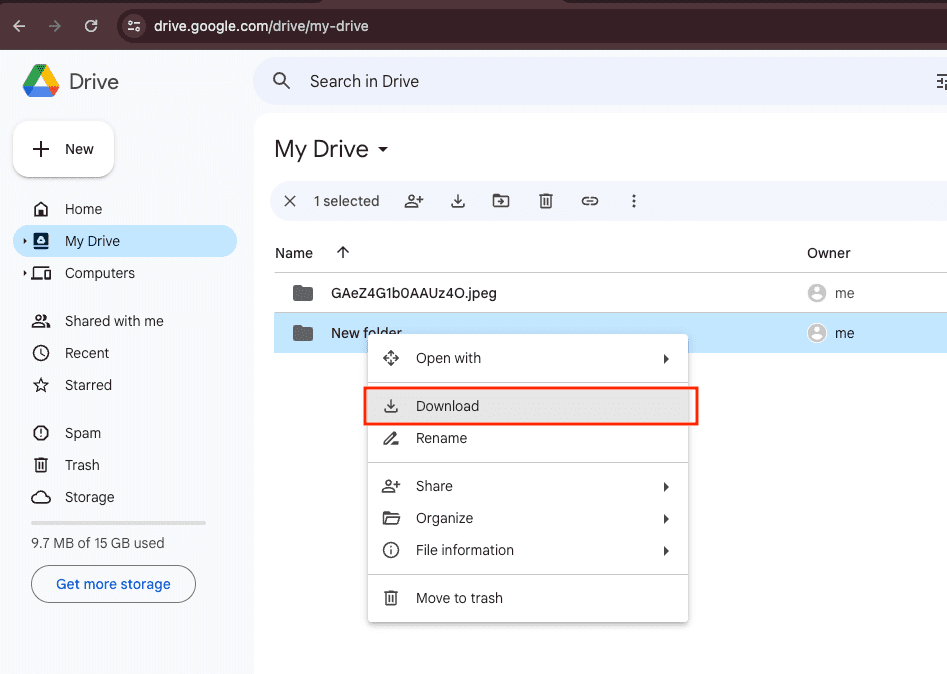
Open Google Drive, select the files or folders you want to move, then right-click and choose Download. Drive zips folders automatically; large selections may arrive as several archives. Extract any zips once downloaded.
Step 2: Sign in to the Internxt web app
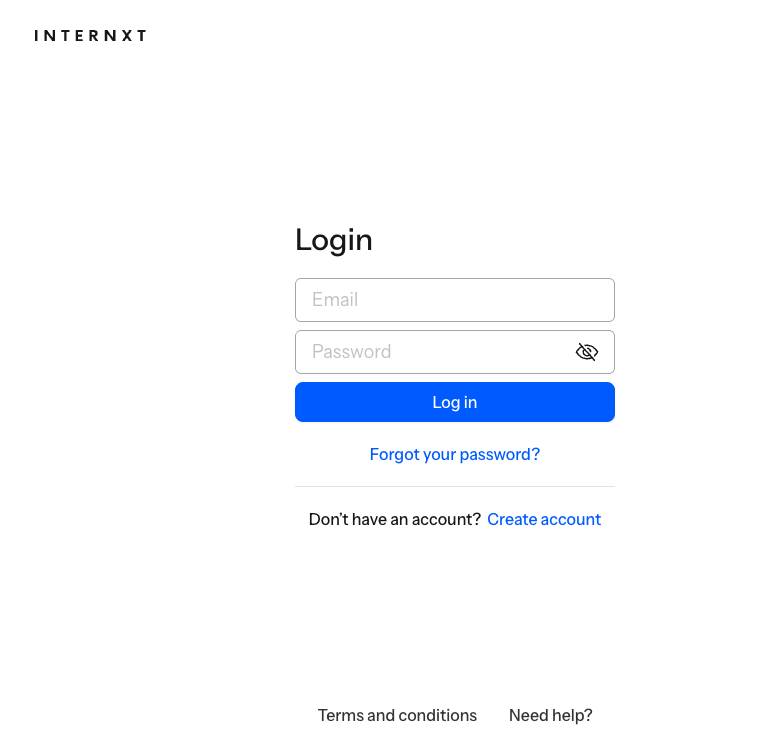
Go to drive.internxt.com and log into your Ultimate account. Enable two-factor authentication first if you have not already, since the account now holds your archive.
Step 3: Upload to Internxt
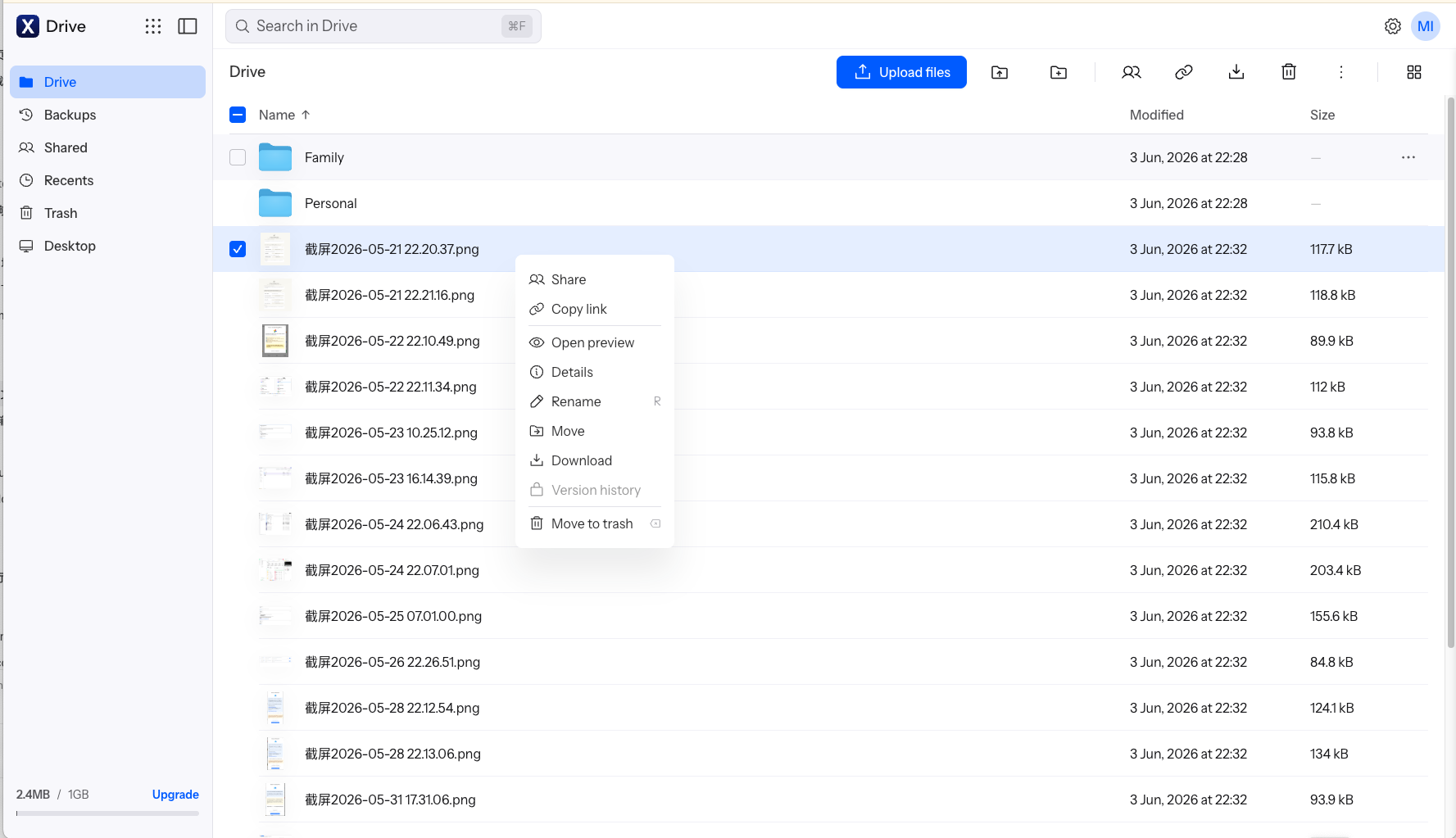
Use the upload button or drag files into the Internxt web app. Files are encrypted in your browser before they leave your device. The web uploader accepts files up to 40 GB each; for very large items, upload in batches to avoid interrupted sessions.
This method needs no third-party tool, but every file travels down to your computer and back up to Internxt — so the speed is limited by your home connection, and a large Drive library can take many hours or days.
Method 2: Transfer Google Drive to Internxt Directly with CloudsLinker
Cloud-to-cloud transfer without local downloads
CloudsLinker moves files directly between Google Drive and Internxt on the server side. Your data does not pass through your computer, and the job keeps running after you close the browser — useful for large or slow migrations.
Step 1: Connect Google Drive
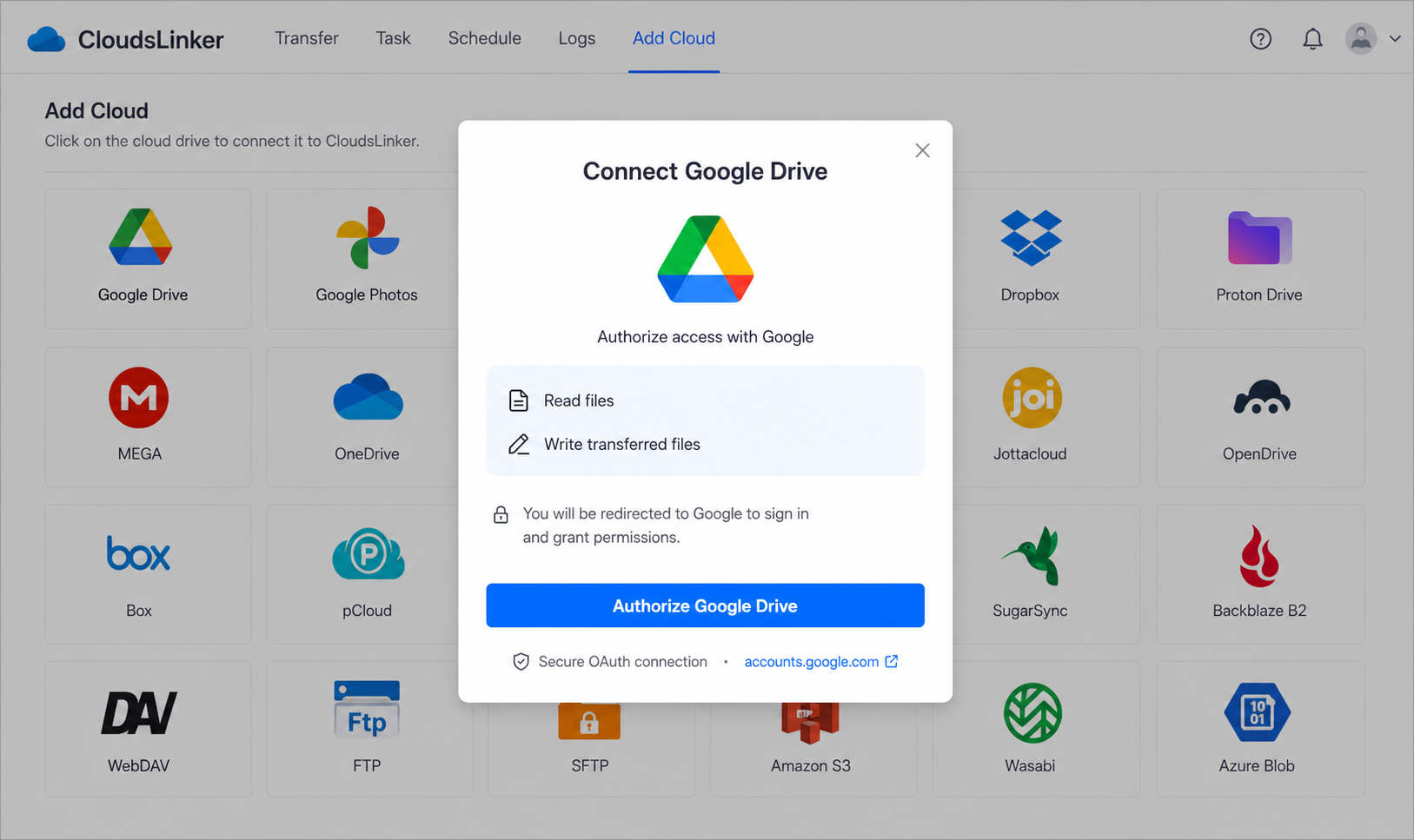
Sign in to CloudsLinker, click Add Cloud and choose Google Drive. You are redirected to Google's official sign-in at accounts.google.com to approve access. After approval you return to CloudsLinker with Drive connected.
Step 2: Connect Internxt
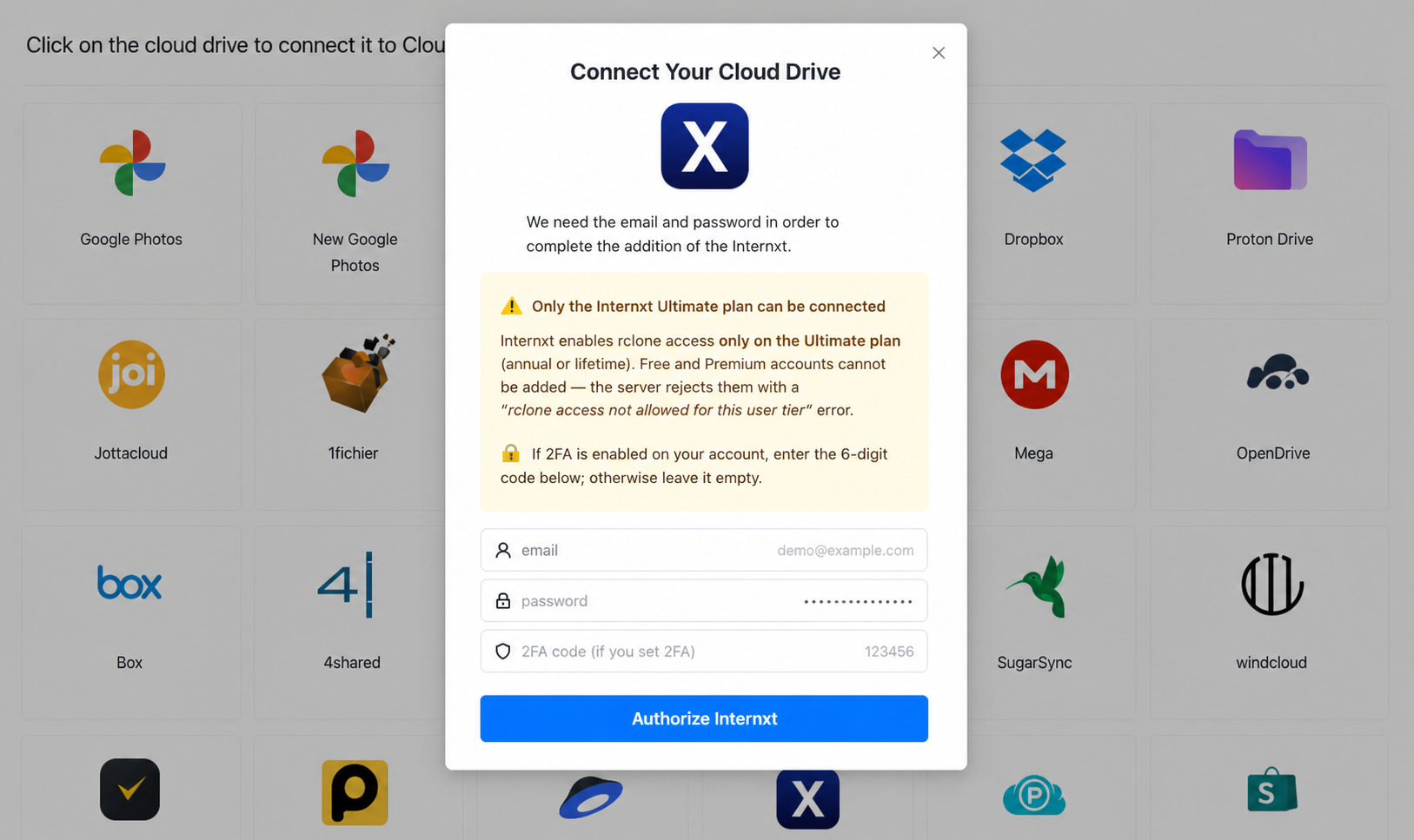
Click Add Cloud again and select Internxt. Enter your Internxt account email and password, plus a 6-digit 2FA code if enabled. The account must be on the Ultimate plan, or the connection is refused with a tier-permission error.
Step 3: Configure the transfer
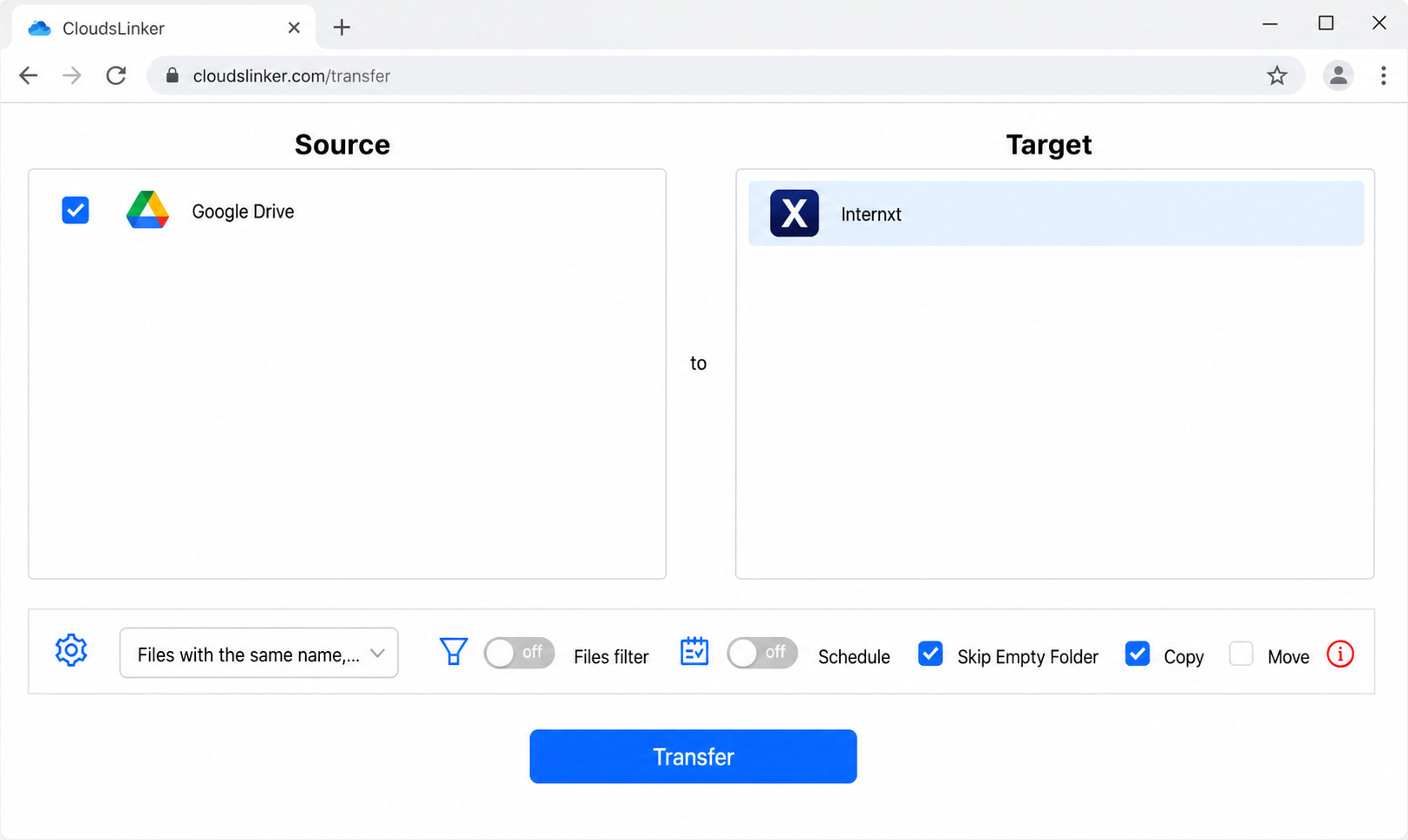
Open the Transfer section. Set Google Drive as the source and browse to the files or folders to move; set Internxt as the destination directory. Optionally filter by file type or date, and pick Copy (keep originals) or Move (delete from Drive after success).
Step 4: Start and monitor
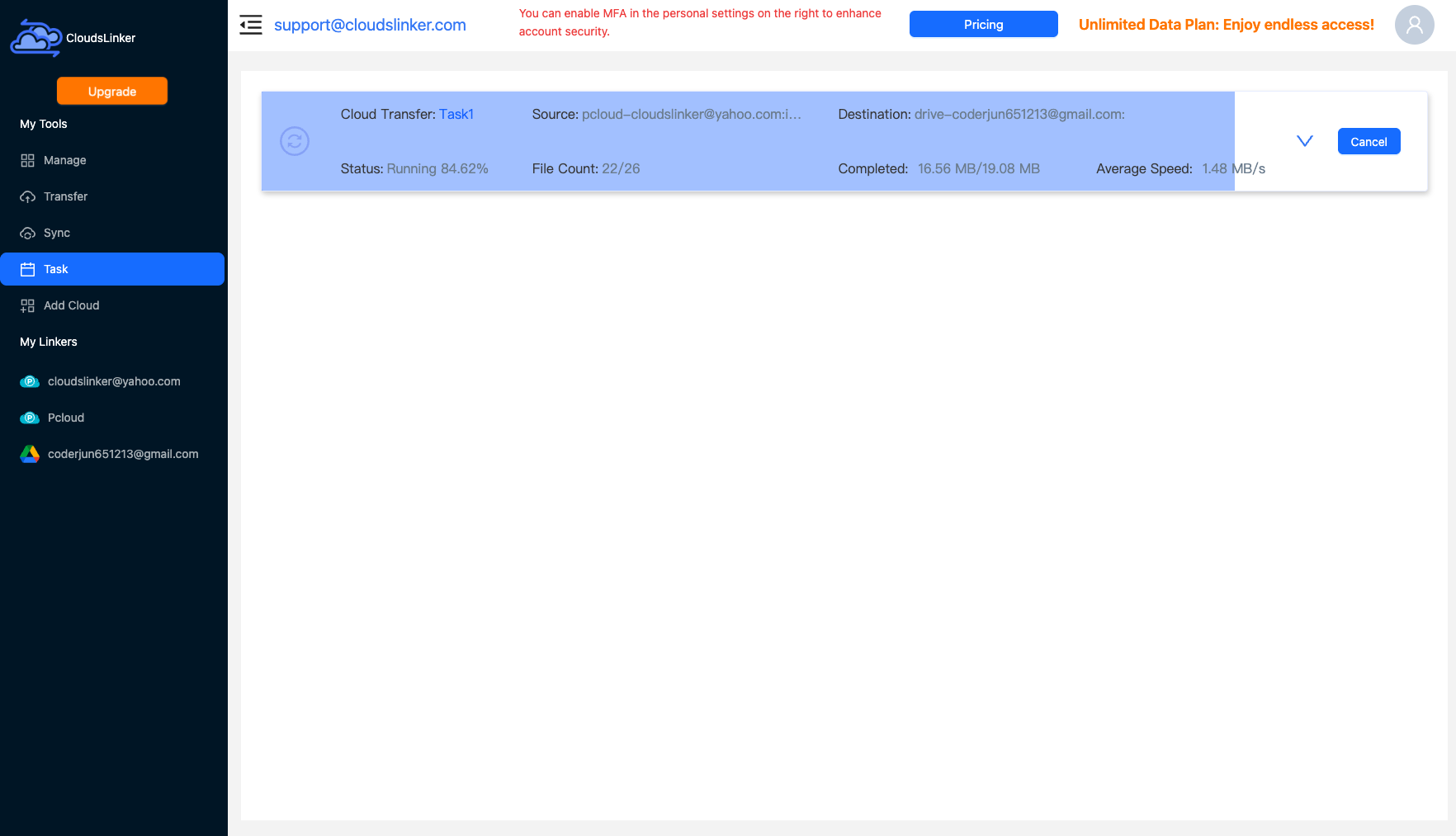
Start the transfer and track it from the Task List, which shows transferred size, speed and remaining items. The job runs entirely in the cloud, so your device does not need to stay online.
After Moving to Internxt
Verify and organize your files
Confirm the migration landed correctly before removing anything from Google Drive:
- Spot-check file counts and sizes: Compare a few folders in Internxt against the originals in Drive to confirm everything copied intact.
- Recreate your folder structure: Arrange the imported files in Internxt to match how you worked in Drive, so nothing feels lost.
Harden your new account
Since Internxt now holds your archive, lock the account down:
- Enable two-factor authentication: Turn on 2FA in Internxt settings to protect access even if your password leaks.
- Store your recovery mnemonic safely: Zero-knowledge encryption means a lost mnemonic equals lost data — keep it somewhere secure and offline.
Google Drive to Internxt — Frequently Asked Questions
Do I need a paid Internxt plan to transfer files in?
What is the largest file I can move to Internxt?
Will Google be able to read my files after they move to Internxt?
Are Google Docs, Sheets and Slides transferred?
Does CloudsLinker keep my folder structure?
How is the connection to each cloud secured?
Conclusion
For a few files, downloading from Google Drive and re-uploading through the Internxt web app is enough. For a large Drive library, the manual route is slow and bottlenecked by your home connection, and Internxt's rclone path caps single files at 40 GB. A direct cloud-to-cloud transfer with CloudsLinker avoids the local round trip and runs unattended — the practical choice once you are moving more than a few gigabytes. Remember that Internxt's rclone access requires an Ultimate plan before either tool can connect.
Online Storage Services Supported by CloudsLinker
Transfer data between over 58 cloud services with CloudsLinker

OneDrive

Google Drive

Google Photos

Shared Drive

OneDrive for Business

Dropbox

Box

Mega

pCloud

Yandex
ProtonDrive

AWS
GCS

iDrive

Storj

DigitalOcean

Wasabi

1fichier

PikPak

TeleBox

OpenDrive

Backblaze B2

Fastmail file
SharePoint

Nextcloud

ownCloud

Premiumize me

HiDrive

Put.io

Sugar Sync

Jottacloud

Seafile

Ftp

SFtp

NAS

WebDav

4shared

Icedrive

Cloudflare R2

Scaleway

Hetzner Object Storage

Synology C2 Object Storage

S3 Compatible

Doi

iCloud Drive
iCloud Photos

FileLU

Zoho WorkDrive

Telia Cloud / Sky

Drime

Filen

TeraBox

Internxt

Degoo

Gofile

Pixeldrain

Shade

Koofr
Didn' t find your cloud service? Be free to contact: [email protected]
Further Reading
Effortless FTP connect to google drive: Transfer Files in 3 Easy Ways
Learn More >
Google Photos to OneDrive: 3 Innovative Transfer Strategies
Learn More >
Google Photos to Proton Drive: 3 Effective Transfer Techniques
Learn More >