AWS S3 to TeraBox: Pull Bucket Files Into a Browsable 1 TB Free Tier
Move AWS S3 objects to TeraBox's 1 TB free tier for easy browsing and sharing of smaller files. S3 client download or cloud-to-cloud transfer with CloudsLinker.
Introduction
TeraBox gives a personal account 1 TB of free storage with a friendly app and shareable links — a different shape from AWS S3, which is programmatic object storage billed per gigabyte plus egress and request fees. Pulling files out of an S3 bucket into TeraBox makes sense when you have media or documents that you would rather browse and share through a consumer app than address through the S3 API or pay egress to retrieve repeatedly. There is one hard limit to plan around: TeraBox caps a single free file at 4 GB, so large database dumps, disk images, or video masters that often live in S3 will not fit a free account. AWS S3 connects with an access key, secret key, and region; TeraBox connects by browser cookie. This guide covers an S3 client download and a cloud-to-cloud transfer with CloudsLinker.
Amazon S3 is AWS object storage addressed through the S3 API. It is built for applications and infrastructure, billed per GB stored plus egress and request charges.
- Model: buckets and object keys, no real folders.
- Billing: per GB + egress + requests.
- Per-object size: up to 5 TB.
- Access: Access Key ID + Secret Access Key + Region.
- Interface: API, CLI, S3-compatible clients.
TeraBox is a consumer file locker from Flextech Inc. with a 1 TB advertised free tier and a friendly browsing and sharing app — suited to smaller files, not large archives.
- Free quota: 1 TB advertised; ~80 GB practical (20-file cap).
- Per-file cap: 4 GB free / 20 GB Premium.
- Model: plain folder tree with a consumer app.
- Cost: free tier; no egress fees.
- Access: browser cookie (
ndus,ndut_fmt); no OAuth.
S3 is infrastructure-grade object storage for programs; TeraBox is a consumer app for people. Moving between them only makes sense for files a person wants to browse — and only those under the free per-file cap.
| Feature | AWS S3 | TeraBox |
|---|---|---|
| Primary use | Application/infrastructure storage | Personal browsing and sharing |
| Billing | Per GB + egress + requests | Free tier; no egress |
| Per-file size | Up to 5 TB | 4 GB free / 20 GB Premium |
| Interface | API, CLI, S3 clients | Consumer app and web |
| Third-party access | Access Key + Secret + Region | Browser cookie only |
On the AWS side
- Inventory object sizes: anything over 4 GB will not fit a free TeraBox account. S3 buckets often hold large archives — filter for the smaller, browsable files.
- Create an access key: IAM → Users → Security Credentials → Create Access Key. Note the region of the bucket.
- Budget for egress: pulling data out of S3 incurs egress charges. Estimate the cost before a large move.
On the TeraBox side
- Create a TeraBox account at terabox.com.
- Create a target folder such as
/S3-Import/. - Decide on a tier: free if all objects are under 4 GB, Premium otherwise.
Method 1: S3 Client Download (Cyberduck / rclone), Upload to TeraBox
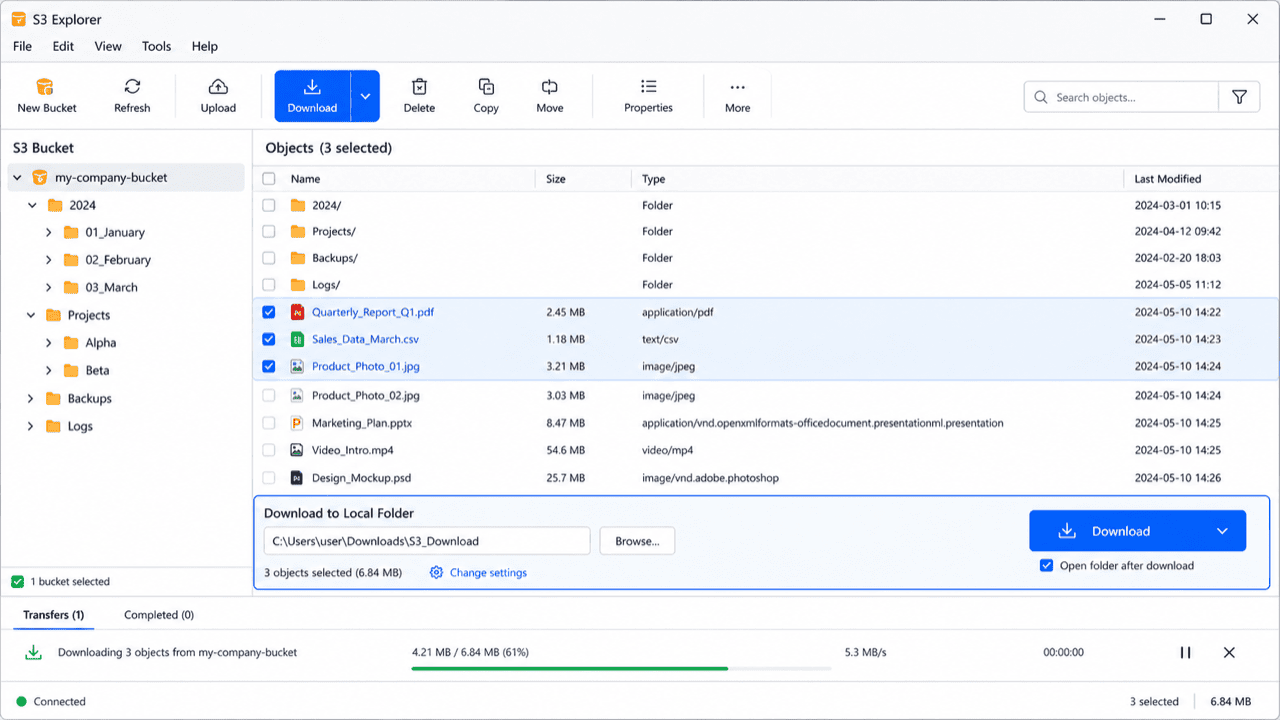
Step 1: Download Objects from S3
Configure an S3 client with your Access Key ID, Secret Access Key, and region. With
Cyberduck you browse
the bucket and drag objects out; with rclone
you run rclone copy s3:bucket/path ./local. Pull the files you want into a local
folder.
Step 2: Filter Oversized Files and Upload to TeraBox
Set aside any object over 4 GB if you are on a free account. Open
terabox.com, open
your /S3-Import/ folder, and drag the rest in.
Method 2: Cloud-to-Cloud Transfer with CloudsLinker
Move Objects Server-Side, Without Repeated Local Egress
CloudsLinker connects AWS S3 with your access key and TeraBox by session cookie, transferring objects between them server-side. Egress is still billed by AWS, but it flows once to CloudsLinker rather than down to your machine and back up.
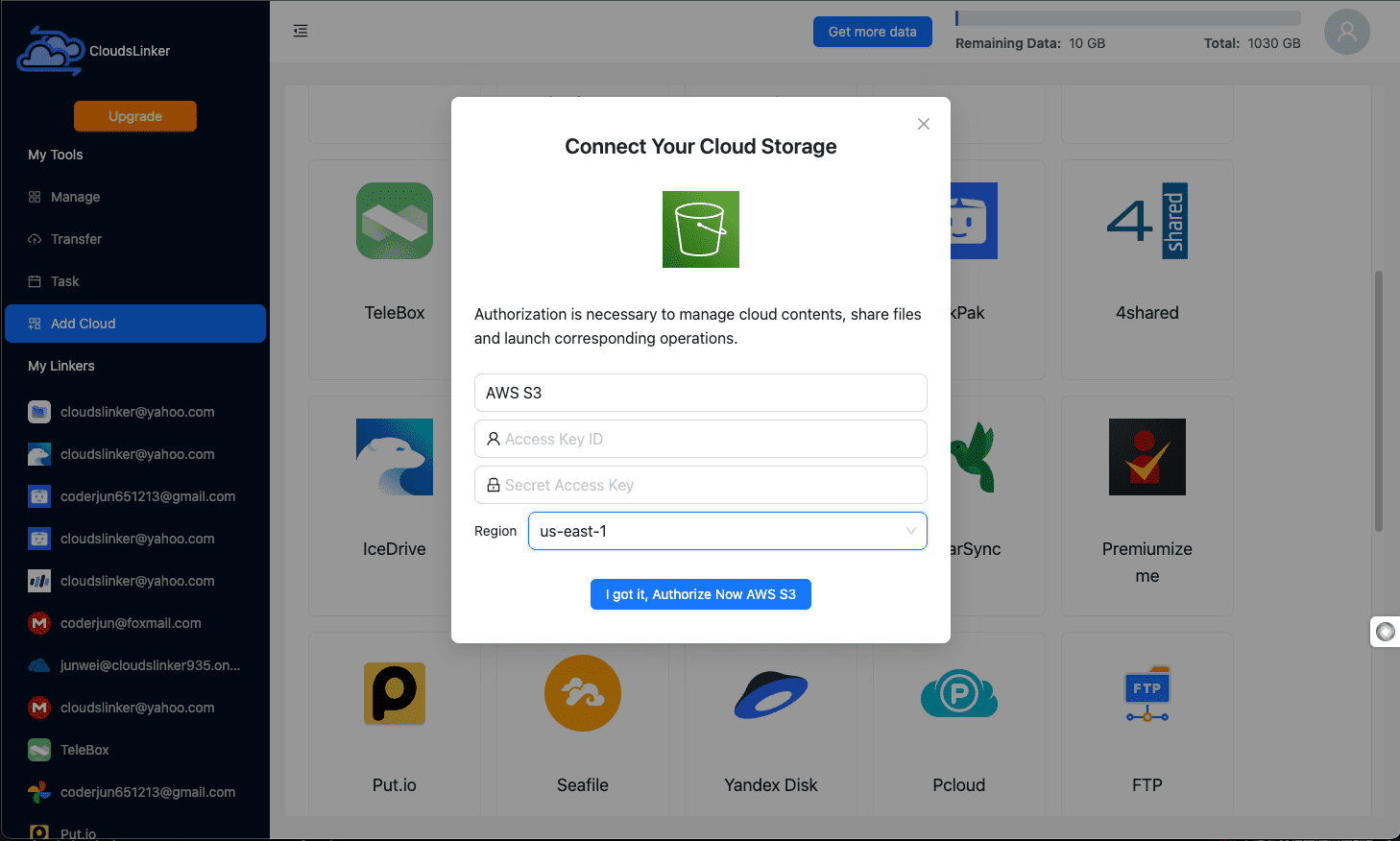
Step 1: Connect AWS S3
In CloudsLinker, click Add Cloud → AWS S3. Enter a display name, your Access Key ID, Secret Access Key, and the bucket Region. Confirm to connect.
Step 2: Connect TeraBox (Browser Cookie)
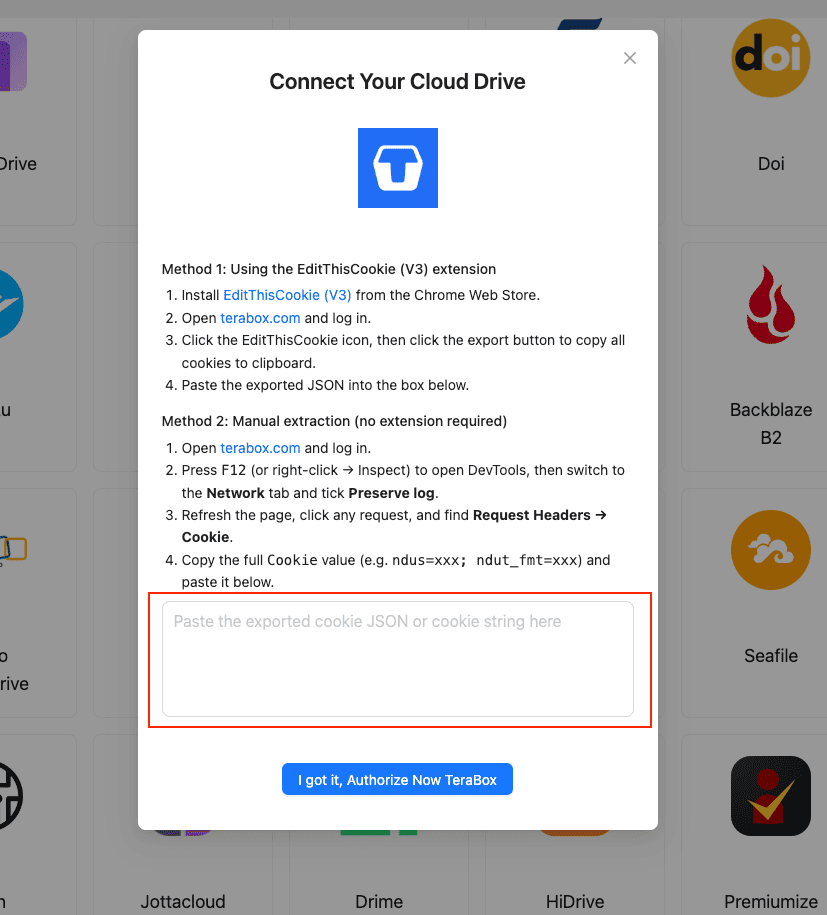
TeraBox has no OAuth, so use the session cookie:
- Install EditThisCookie (V3) in Chrome.
- Open
www.terabox.comin the same browser, signed in. - Click EditThisCookie → Export and paste the cookie JSON into CloudsLinker.
Or copy the Cookie header (ndus=...; ndut_fmt=...) from DevTools (F12) → Network.
Step 3: Configure the Transfer
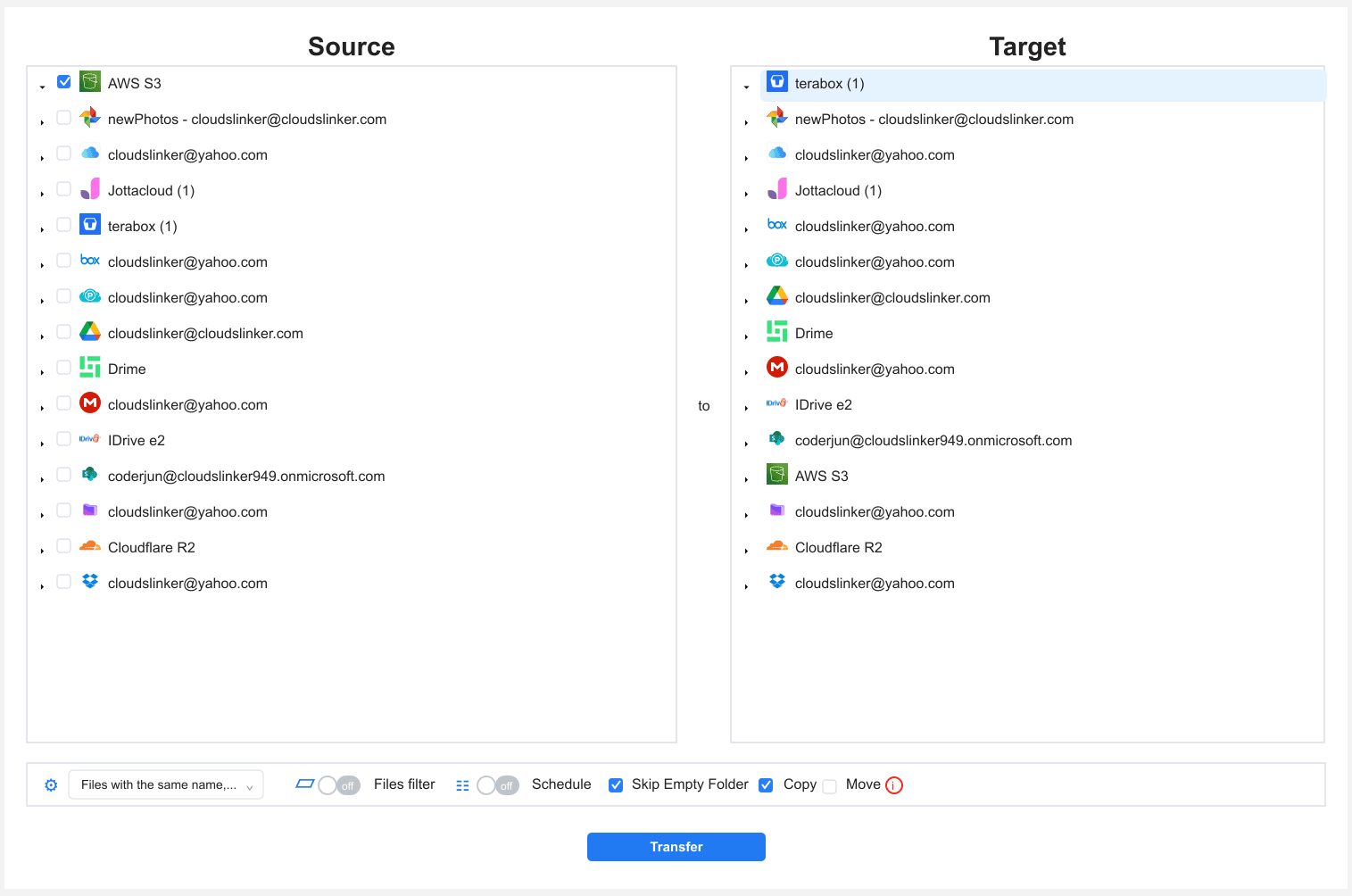
In the Transfer section, set AWS S3 as the source, browse to the
bucket and prefix, and set TeraBox as the destination with your
/S3-Import/ folder. Apply a 4 GB size filter for free TeraBox and use
type filters to pull only browsable files. Copy keeps the bucket intact.
Step 4: Start and Monitor
Start the task and track it in the Task List. If the TeraBox cookie expires, the task pauses for a fresh one. Verify in TeraBox; the S3 objects stay in place under Copy mode.
Method Comparison
| Method | Ease of Use | Speed | Best For | Uses Local Bandwidth | Skill Level |
|---|---|---|---|---|---|
| S3 Client + Upload | ★★★☆☆ | ★★☆☆☆ | A few objects, ad hoc pulls | Yes (egress + upload) | Intermediate |
| CloudsLinker | ★★★★★ | ★★★★☆ | Larger sets of suitably sized files | No | Beginner |
- The 4 GB cap decides fit: TeraBox suits buckets of photos, documents, and small media. Large backups, VM images, and video masters do not belong on a free TeraBox tier.
- Estimate egress cost first: AWS bills egress on every byte leaving S3. A large move has a real dollar cost — check it before starting.
- Use a scoped IAM key: create a read-only access key limited to the bucket you are moving, and delete it afterward.
- Object keys become folders: S3 key prefixes like
photos/2024/map to nested folders in TeraBox. - Refresh the TeraBox cookie before long jobs: re-login right before exporting it.
- Do not treat TeraBox as infrastructure: it has no API, versioning, or SLA — it is a consumer convenience copy.
Frequently Asked Questions
media/clips/a.mp4 lands at the same path under your TeraBox target folder.Conclusion
For a handful of objects, an S3 client like Cyberduck or rclone downloads them locally for upload to TeraBox. For a larger set of suitably sized files, CloudsLinker connects AWS S3 with your access key and TeraBox by session cookie and runs the move server-side, sidestepping repeated egress through your own machine. The 4 GB free per-file cap is the deciding constraint — TeraBox fits S3 buckets full of photos, documents, and small media far better than buckets of large archives. Mind egress costs on the AWS side and verify the copy before deleting anything.
Online Storage Services Supported by CloudsLinker
Transfer data between over 58 cloud services with CloudsLinker

OneDrive

Google Drive

Google Photos

Shared Drive

OneDrive for Business

Dropbox

Box

Mega

pCloud

Yandex

ProtonDrive

AWS

GCS

iDrive

Storj

DigitalOcean

Wasabi

1fichier

PikPak

TeleBox

OpenDrive

Backblaze B2

Fastmail file
SharePoint

Nextcloud

ownCloud

Premiumize me

HiDrive

Put.io

Sugar Sync

Jottacloud

Seafile

Ftp

SFtp

NAS

WebDav

4shared

Icedrive

Cloudflare R2

Scaleway

Hetzner Object Storage

Synology C2 Object Storage

S3 Compatible

Doi

iCloud Drive

iCloud Photos

FileLU

Zoho WorkDrive

Telia Cloud / Sky

Drime

Filen

TeraBox

Internxt

Degoo

Gofile

Pixeldrain

Shade

Koofr
Didn' t find your cloud service? Be free to contact: [email protected]
Further Reading
Effortless FTP connect to google drive: Transfer Files in 3 Easy Ways
Learn More >
Google Photos to OneDrive: 3 Innovative Transfer Strategies
Learn More >
Google Photos to Proton Drive: 3 Effective Transfer Techniques
Learn More >