Footage Buried in Google Drive? Give It a Searchable Home in Shade
Move video libraries from Google Drive folders into Shade drives — dialogue search, editor panels and review tools. Docs stay; the media graduates.
Introduction
Shade treats a video library as something to query, not just store: type what was said or what's on screen, and the AI index finds the clip — no tags, no filename archaeology. Google Drive is where team footage usually accumulates, because it's already there for the Docs and Sheets; but Drive's search reads documents, not dailies, and reviewing a cut means downloading it or squinting at a preview. The clean split is to leave the documents where Workspace shines and move the media into a Shade drive ($20 per seat/month, 500 GB active storage per seat, unlimited AI indexing). Since Google-native files aren't involved, this migration is pure media — no format conversions, just bulk weight. Two methods below: manual, and a server-side copy with CloudsLinker.
Google Drive is the storage layer of Google Workspace — excellent for Docs, Sheets and collaboration, with 15 GB free and Google One tiers to 2 TB ($9.99/mo). Video files sit in it as opaque blobs: storable, previewable, but not searchable by content.
- 15 GB free shared; 2 TB at $9.99/mo
- Document-first search and collaboration
- No dialogue/visual indexing for video
- OAuth access for transfer tools
Shade is media-first team storage: AI search across dialogue and visuals, review/approval workflows, full-resolution streaming, and panels inside Premiere Pro and DaVinci Resolve. $20 per seat/month with 500 GB active storage per seat.
- Natural-language search over footage content
- Unlimited drives and AI indexing
- Up to 15 seats + 150 guest collaborators
- API key + per-drive Drive ID access
| Feature | Google Drive | Shade |
|---|---|---|
| Search on video | Filename only | Dialogue + visual content, plain English |
| Review workflow | Comments on files | Frame-accurate review and approval |
| Editor integration | None | Premiere Pro / Resolve panels, mountable drives |
| Pricing | 2 TB — $9.99/mo (per account) | $20/seat/mo — 500 GB active per seat |
| Native document formats | Docs / Sheets / Slides | None — media-focused storage |
| Connection in CloudsLinker | Google OAuth | API key + Drive ID |
Sources: Google: storage and upload limits, Google Drive API limits, Shade: official site, Capterra: Shade pricing.
Locate where the media actually lives — team footage tends to scatter across My Drive folders, shared drives and 'Shared with me' items, and only content in drives you control migrates cleanly (shortcut anything critical into your own tree first). Decide the drive layout in Shade (per client, per show) and note each target drive's Drive ID; generate an API key in account settings. Plan the filter up front: video and image formats move, Workspace documents stay. And check the seat arithmetic — 500 GB active per seat — so the working set fits without immediately needing an archive rotation.
Method 1: Download and Re-upload by Hand
Step 1: Download the media folders from drive.google.com
Select the footage folders at drive.google.com and choose Download. Drive zips the selection — video-heavy folders arrive as a series of multi-GB archives that need local disk space to extract.
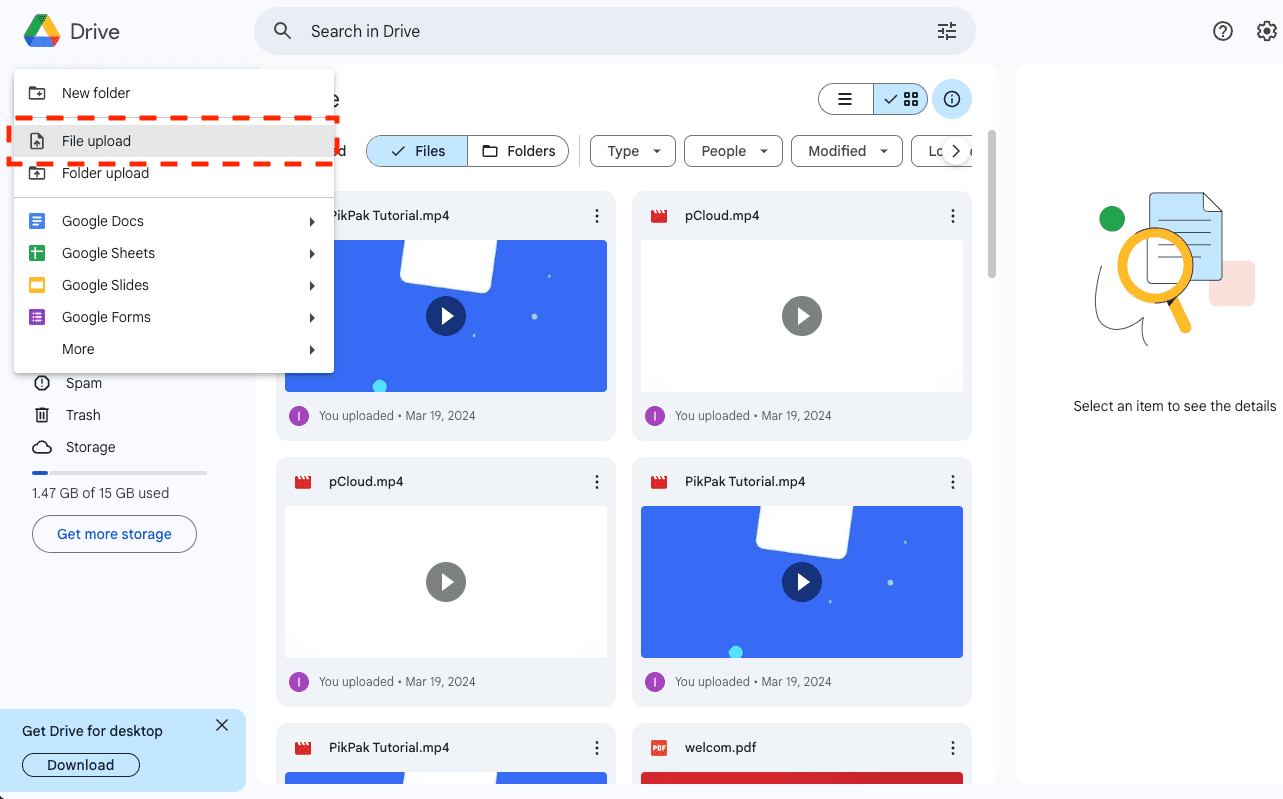
Step 2: Upload into the Shade drive
Open the target drive in Shade's web app and upload the extracted folders; indexing starts as files land. The office uplink is the constraint — at typical business upload speeds, each terabyte is roughly a day of saturated connection.
Method 2: Copy Google Drive to Shade in the Cloud
Media out of Drive, documents left in place
CloudsLinker reads Drive over OAuth with automatic back-off on Google's API rate limits, filters to the media formats you choose, and writes into the Shade drive by API key + Drive ID. The documents stay in Workspace; only the footage graduates — with no office bandwidth consumed.
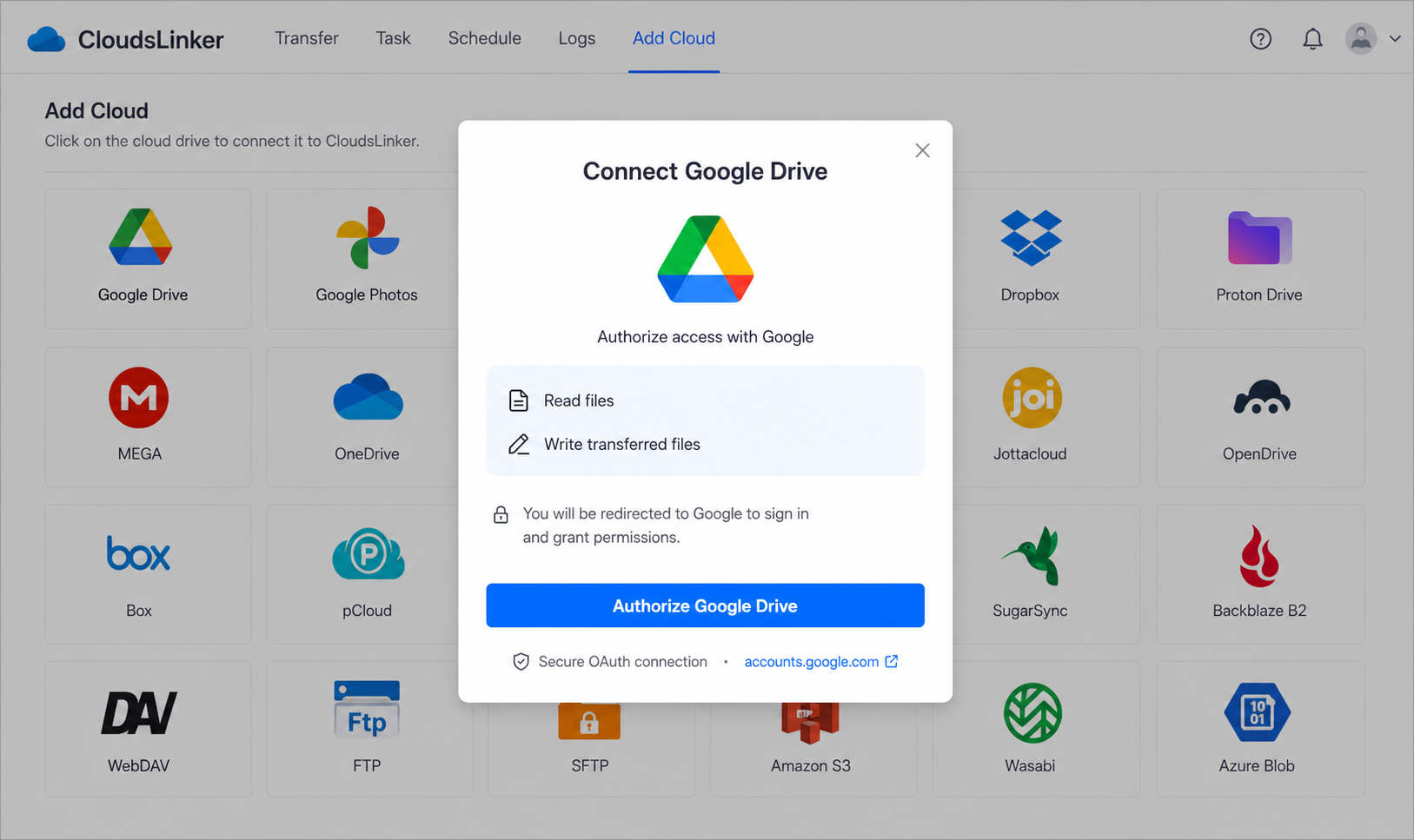
Step 1: Connect Google Drive
Click Add Cloud → Google Drive and approve access on Google's consent page at accounts.google.com. The token is revocable from your Google account's third-party access settings.
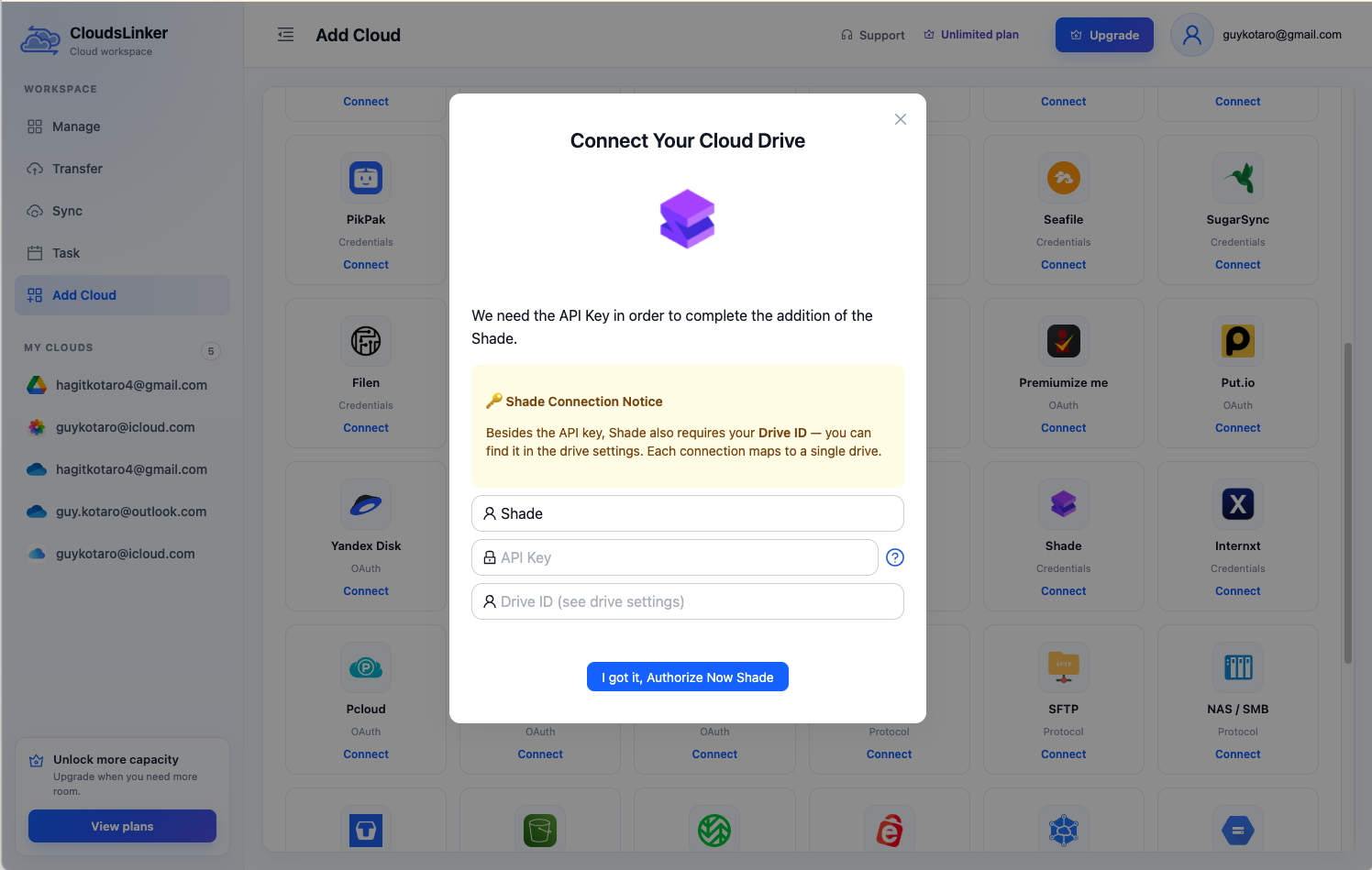
Step 2: Connect Shade
In Shade, create an API key (account settings) and copy the target drive's Drive ID (drive settings). Then click Add Cloud → Shade in CloudsLinker, paste both, and confirm — the connection is scoped to that one drive.
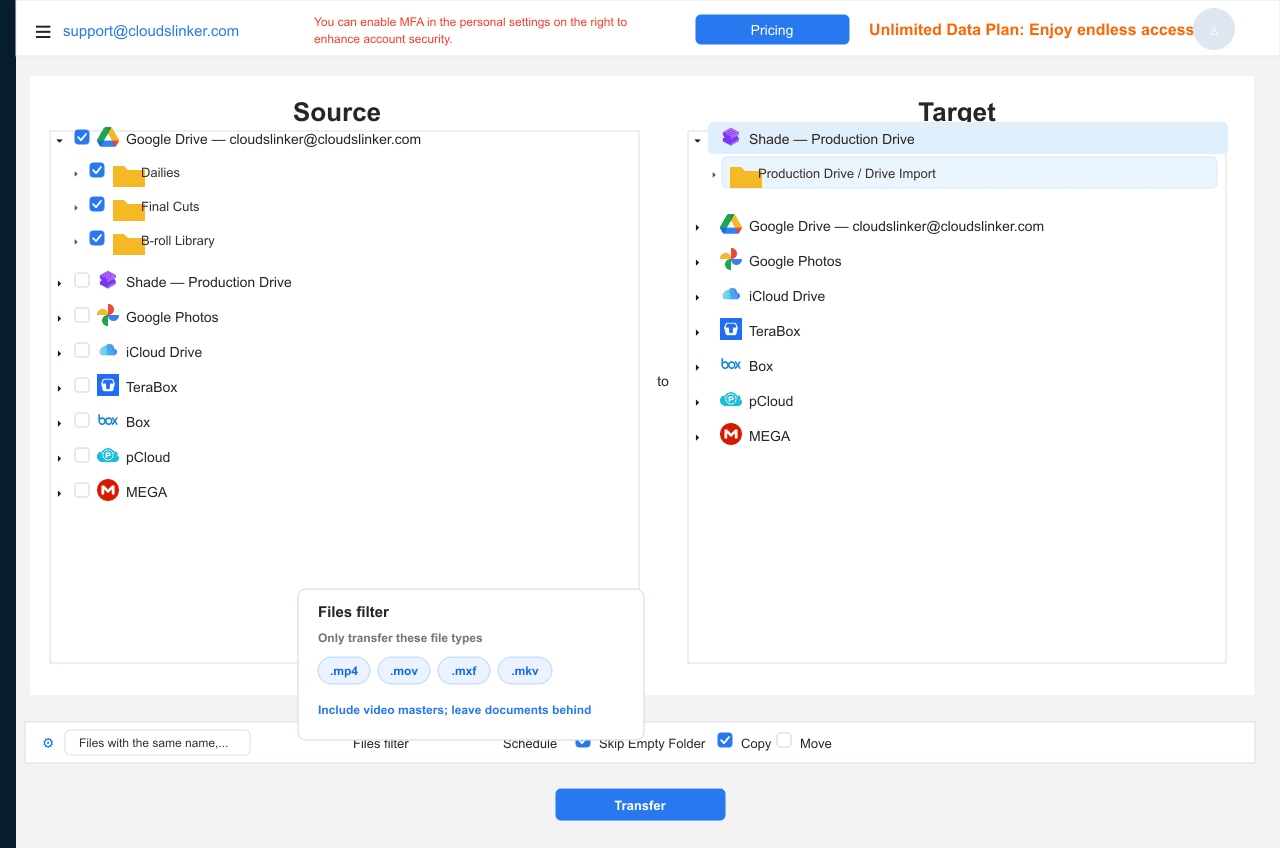
Step 3: Configure the Transfer
Set Google Drive as the source, tick the footage folders, and set the Shade drive as the destination. Apply a format filter — .mp4, .mov, .mxf, images — so Docs, Sheets and project clutter stay in Drive where they belong.
Step 4: Start and Monitor the Transfer
Start the job and follow the Task List. Rate-limit pauses on the Google side are handled automatically; by completion, earlier files are already searchable in Shade.
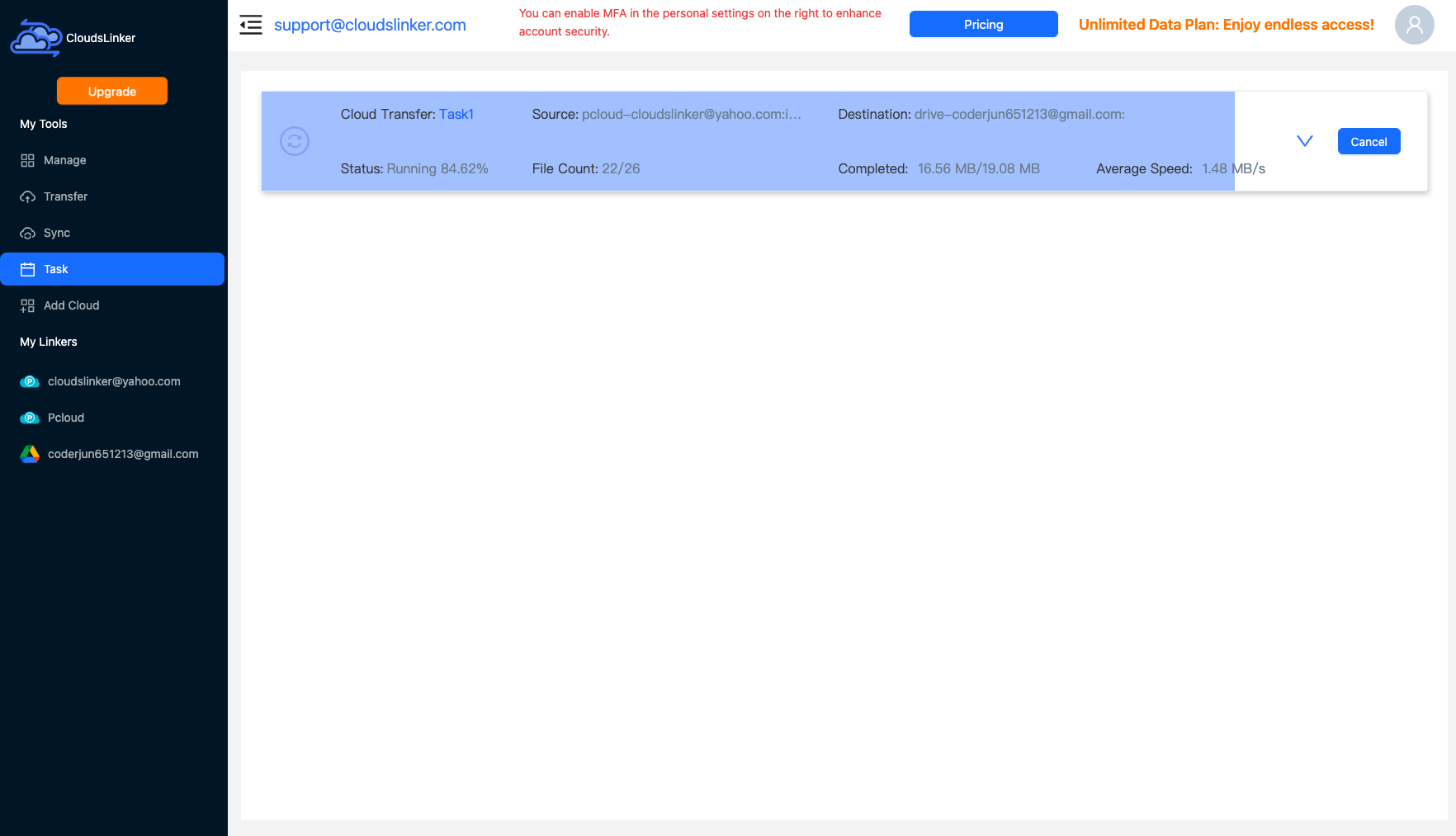
Comparing the Ways to Transfer From Google Drive to Shade
| Method | Ease of Use | Speed | Best For | Uses Local Bandwidth | Skill Level |
|---|---|---|---|---|---|
| Manual download / upload | Medium | Slow (uplink-bound) | A single shoot's folder | Yes — twice | Basic |
| CloudsLinker | Easy | Fast (server-side) | Department-scale media libraries | No | Basic |
- Filter to media formats: the clean split is footage to Shade, documents in Workspace — a format filter enforces it automatically.
- Chase down 'Shared with me': files others own aren't in your My Drive and won't transfer — add shortcuts or request copies first.
- Pilot one project: move one folder, let indexing finish, have an editor test search and the NLE panel before queuing the archive.
- Mind the active-storage budget: 500 GB per seat is for the working set — send finished projects to archive storage, not Shade.
- Reclaim Drive quota afterwards: once verified, delete the migrated media and empty Drive's trash — deleted files count against quota for 30 days otherwise.
- One connection per Shade drive: multi-drive layouts need one CloudsLinker connection per Drive ID — sequential migrations keep it tidy.
Frequently Asked Questions
Conclusion
One shoot's folder can move by hand. A department's video history — hundreds of gigabytes scattered across Drive folders and shared links — is a server-side job: CloudsLinker reads Drive over OAuth, paces around Google's API quotas, and writes into the Shade drive while nobody's workstation is involved. Filter to media formats so the documents stay in Workspace, verify in Shade, then reclaim the Drive quota.
Online Storage Services Supported by CloudsLinker
Transfer data between over 58 cloud services with CloudsLinker

OneDrive

Google Drive

Google Photos

Shared Drive

OneDrive for Business

Dropbox

Box

Mega

pCloud

Yandex

ProtonDrive

AWS

GCS

iDrive

Storj

DigitalOcean

Wasabi

1fichier

PikPak

TeleBox

OpenDrive

Backblaze B2

Fastmail file

SharePoint

Nextcloud

ownCloud

Premiumize me

HiDrive

Put.io

Sugar Sync

Jottacloud

Seafile

Ftp

SFtp

NAS

WebDav

4shared

Icedrive

Cloudflare R2

Scaleway

Hetzner Object Storage

Synology C2 Object Storage

S3 Compatible

Doi

iCloud Drive

iCloud Photos

FileLU

Zoho WorkDrive

Telia Cloud / Sky
Drime

Filen

TeraBox

Internxt

Degoo

Gofile

Pixeldrain

Shade

Koofr
Didn' t find your cloud service? Be free to contact: [email protected]
Further Reading
Effortless FTP connect to google drive: Transfer Files in 3 Easy Ways
Learn More >
Google Photos to OneDrive: 3 Innovative Transfer Strategies
Learn More >
Google Photos to Proton Drive: 3 Effective Transfer Techniques
Learn More >