Google Photos to TeraBox: Offload Your Library to 1 TB of Free Space
Move Google Photos to TeraBox for 1 TB free storage. Export with Google Takeout, download in the browser, or run a cloud-to-cloud transfer with CloudsLinker.
Introduction
TeraBox offers 1 TB of advertised free storage, which is what pulls Google Photos users over once their 15 GB Google account — shared with Gmail and Drive — runs out. Since Google ended free unlimited photo backup in 2021, every uploaded image counts against that 15 GB, and the cheapest escape is often a second service rather than a Google One subscription. TeraBox stores photos as plain files in folders, with a 4 GB free per-file cap that only large videos hit. This guide covers three ways to move a Google Photos library: a full Google Takeout export, a browser download for smaller selections, and a cloud-to-cloud transfer through CloudsLinker that connects Google Photos over OAuth and TeraBox through its session cookie.
Google Photos is Google's photo and video service, with search, face grouping, and automatic backup from mobile devices. Storage counts against the 15 GB shared across the Google account.
- Shared quota: 15 GB across Photos, Gmail and Drive.
- Search and grouping: AI-driven search, faces, places, albums.
- Formats: JPEG, HEIC, RAW, video; original or storage-saver quality.
- Export: Google Takeout produces a full archive with album metadata.
- API access: OAuth-based for third-party tools.
TeraBox is a consumer cloud storage service operated by Flextech Inc., the international branch of Baidu Netdisk. It advertises a 1 TB free tier with native apps across platforms.
- Free tier: 1024 GB advertised; ~80 GB practical given the 20 large-file cap.
- Per-file cap: 4 GB free; 20 GB on Premium.
- Layout: plain folder tree — no photo search or albums.
- Connection: no public OAuth — third-party tools use the browser session cookie (
ndus,ndut_fmt). - Cross-platform apps: Windows, macOS, Android, iOS, web.
Google Photos is a managed library with search and grouping; TeraBox is a storage product with a large free quota and no photo intelligence. The migration trades discovery features for capacity.
| Feature | Google Photos | TeraBox |
|---|---|---|
| Data model | Searchable library, albums, faces, places | Plain folder tree |
| Free quota | 15 GB shared with Gmail and Drive | 1 TB advertised; ~80 GB practical |
| Per-file cap | No small cap; quota-bound | 4 GB free / 20 GB Premium |
| Export tooling | Google Takeout with album metadata | Manual upload or cloud-to-cloud |
| Third-party access | OAuth | Browser session cookie |
On the Google Photos side
- Check storage usage at one.google.com/storage to size the move.
- Decide on Takeout vs cloud-to-cloud: Takeout includes album structure and JSON metadata; a direct transfer is simpler but flattens albums into the destination folder.
- Note original vs storage-saver quality: if you uploaded in storage-saver, the originals are already compressed — nothing to recover on export.
- Identify large videos over 4 GB for the free TeraBox cap.
On the TeraBox side
- Create a TeraBox account at terabox.com.
- Plan a folder layout: a date-based tree replaces Google's timeline view.
- Pick a tier: free if all files are under 4 GB, Premium otherwise.
Method 1: Google Takeout Export, Then Upload to TeraBox
Step 1: Request a Takeout Export
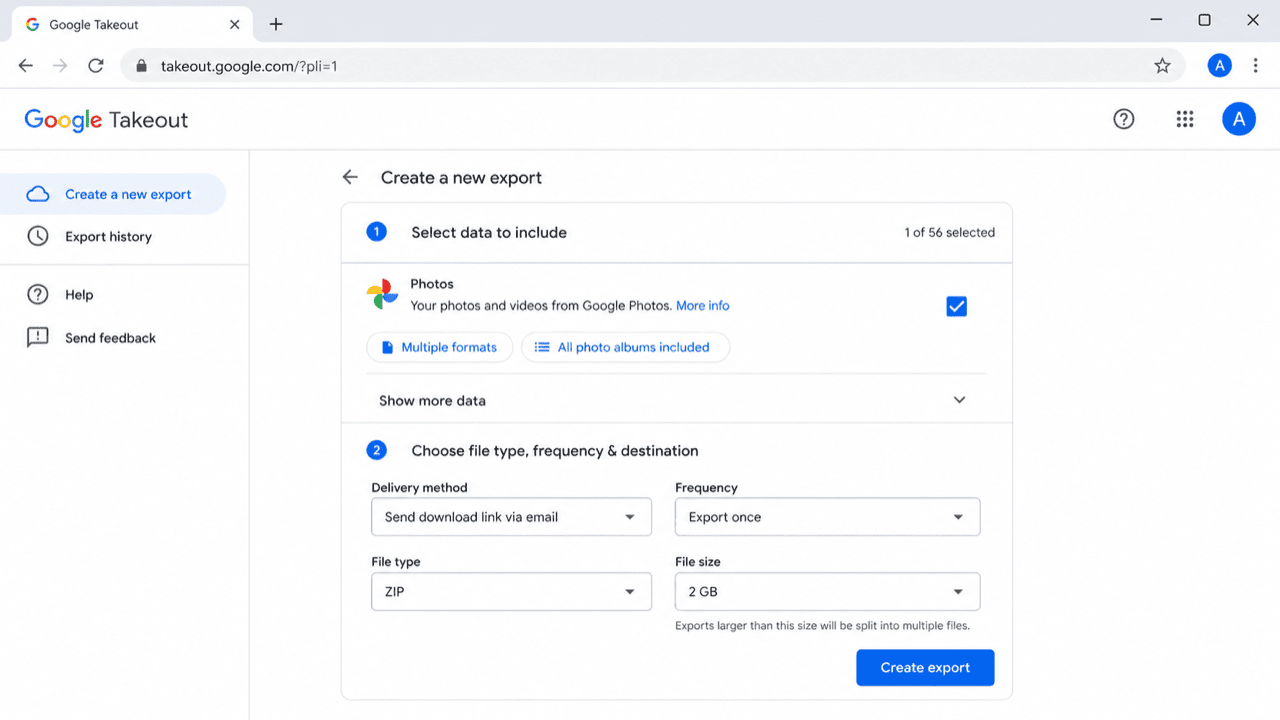
Open takeout.google.com, deselect everything, then select only Google Photos. Choose the album years you want, set the archive format to ZIP, and pick a split size (for example, 4 GB or 10 GB per file). Google emails a download link when the archive is ready — this can take hours to days for large libraries.
Step 2: Extract and Review
Download and unzip the archives. Takeout organizes photos into album folders and includes a
.json sidecar per image with metadata (timestamps, geolocation, descriptions). If
you do not need the JSON files, you can filter them out before upload. Set aside any video over
4 GB.
Step 3: Upload to TeraBox
Open terabox.com and drag the extracted album folders into your target directory. The album structure carries over as folders.
Method 2: Browser Download from Google Photos
Trade-off: manual selection; no metadata sidecars.
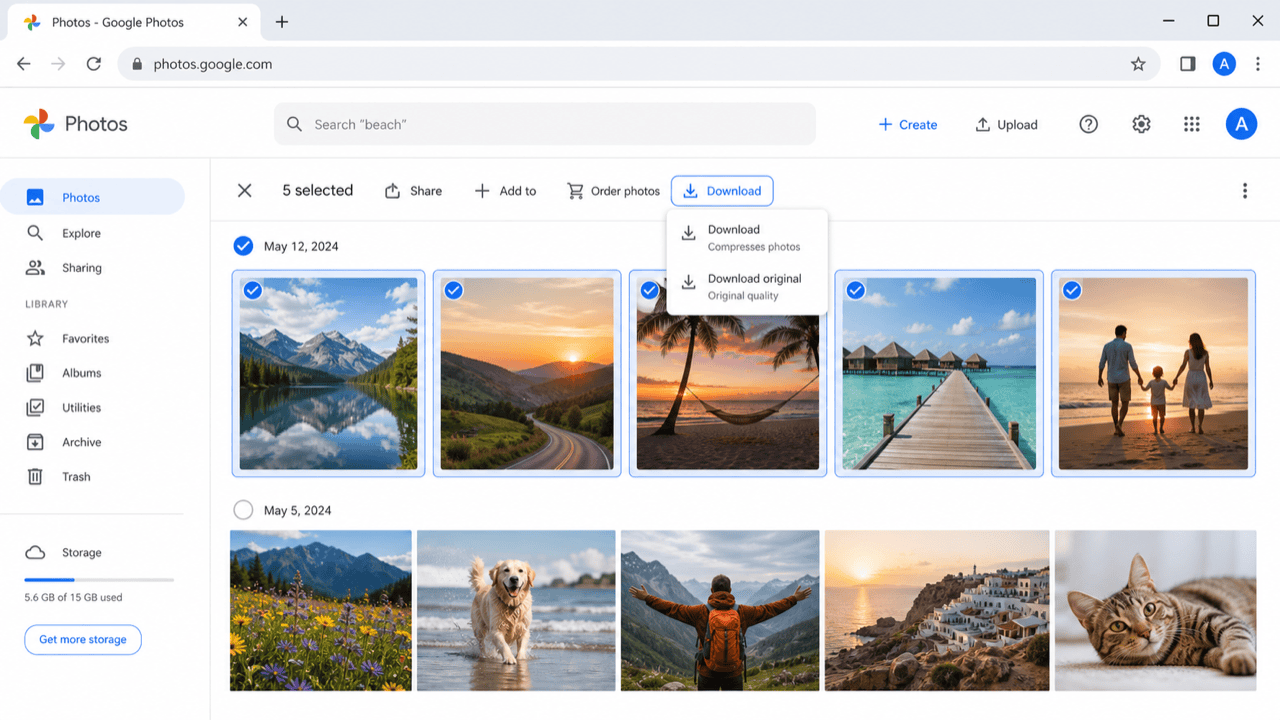
Open photos.google.com,
select photos (click the first, hold Shift, click the last), and use
Shift+D or the menu to download. Google packages the selection as a ZIP. Extract
it, remove anything over 4 GB for free TeraBox, then upload through the TeraBox web app.
Method 3: Cloud-to-Cloud Transfer with CloudsLinker
Move the Library Without Local Downloads
CloudsLinker connects Google Photos over OAuth and TeraBox through its session cookie, then transfers server-side. This avoids the Takeout wait and the local download-then-upload cycle.
Step 1: Connect Google Photos
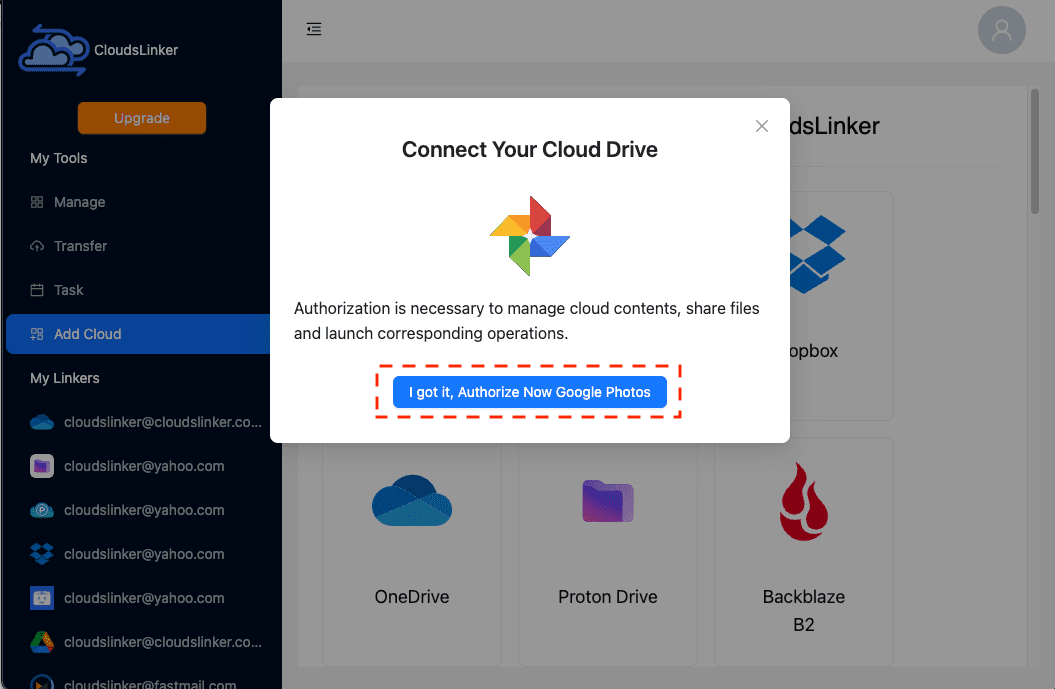
In CloudsLinker, click Add Cloud and select Google Photos. Your browser redirects to Google's OAuth page. Sign in and approve read access to your photo library. Google Photos appears as a connected source.
Step 2: Connect TeraBox (Browser Cookie)
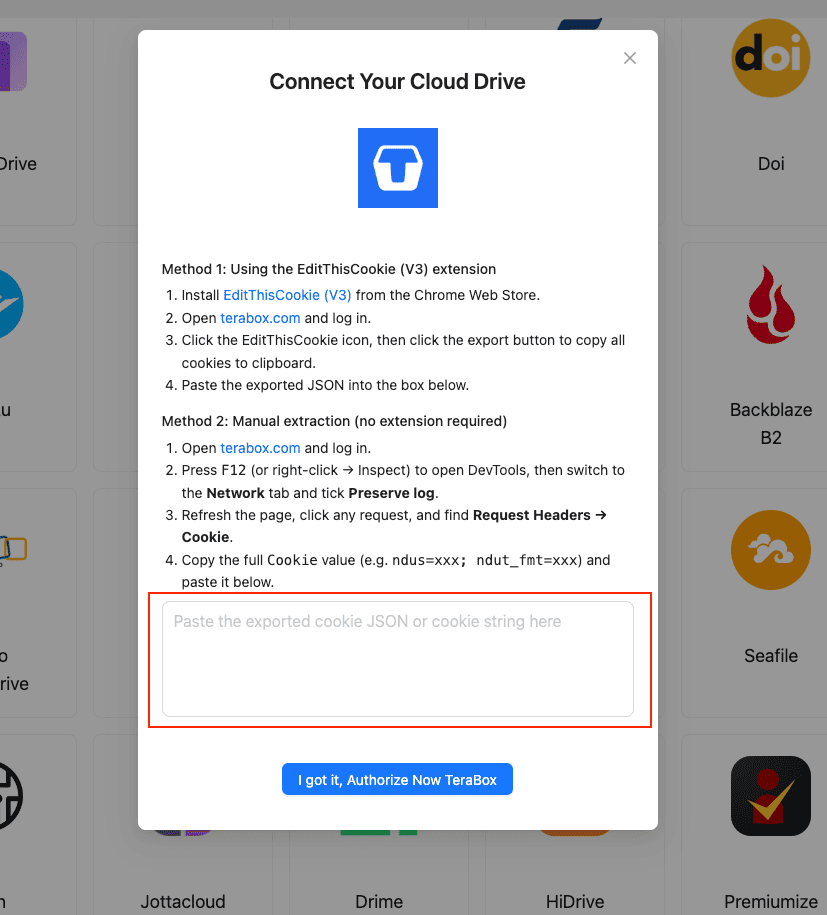
TeraBox has no public OAuth, so the connection uses the cookie from your logged-in TeraBox tab:
- Install EditThisCookie (V3) in Chrome.
- Open
www.terabox.comin the same browser and confirm you are signed in. - Click the EditThisCookie icon → Export. The cookie JSON copies to your clipboard.
- In CloudsLinker, click Add Cloud → TeraBox → enter a display name → paste the JSON → Confirm.
Without an extension, open DevTools (F12) → Network, refresh the
page, and copy the full Cookie header (ndus=...; ndut_fmt=...).
Step 3: Configure the Transfer
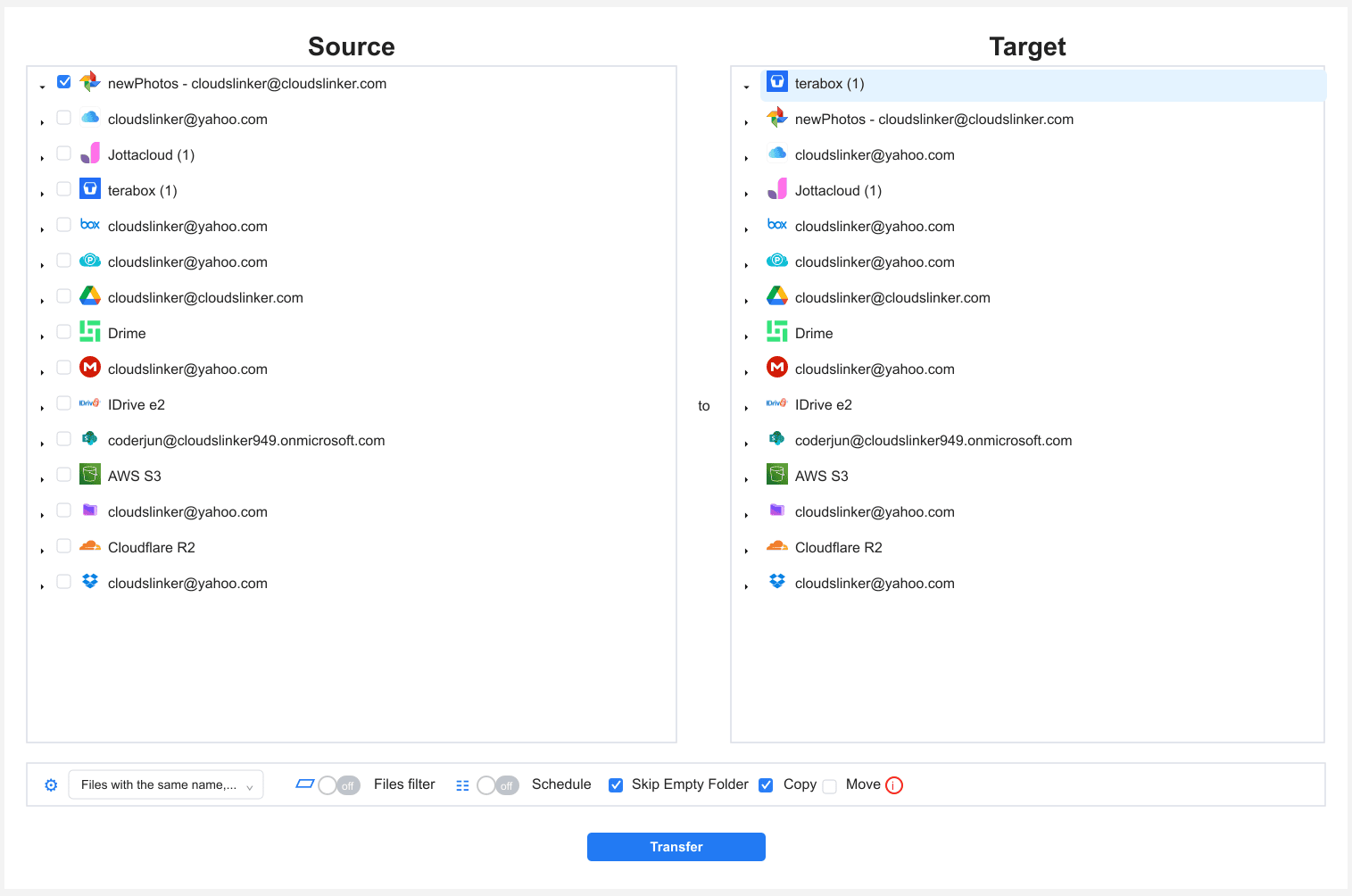
Open the Transfer section. Select Google Photos as the source and browse albums or the full library. Select TeraBox as the destination folder. Apply a 4 GB file-size filter for free TeraBox so oversized videos do not fail. Use Copy to keep the Google library intact.
Step 4: Start and Monitor
Start the task. The Task List shows transferred size and remaining items. If the TeraBox cookie expires, the task pauses and prompts you to paste a fresh one. Verify a sample in TeraBox before freeing up Google storage.
Method Comparison
| Method | Ease of Use | Speed | Best For | Uses Local Bandwidth | Skill Level |
|---|---|---|---|---|---|
| Google Takeout | ★★★☆☆ | ★★☆☆☆ | Full library with album metadata | Yes | Intermediate |
| Browser Download | ★★★★☆ | ★★☆☆☆ | A few albums or selections | Yes | Beginner |
| CloudsLinker | ★★★★★ | ★★★★★ | Large libraries, hands-off moves | No | Beginner |
-
Decide what to do with Takeout JSON files: each photo gets a
.jsonsidecar with metadata. Keep them if you may re-import elsewhere; filter them out if you only want the images. - Only videos hit the 4 GB cap: photos stay well under it. Filter long videos for free TeraBox.
- Storage-saver uploads are already compressed: if you never used original quality, there is no full-resolution version to export.
- Recreate a date or album folder structure: TeraBox has no search or faces. Folder organization is your only navigation aid.
- Refresh the TeraBox cookie before long jobs: re-login right before exporting the cookie.
- Verify a sample first: move one album, open files in TeraBox, then queue the rest.
Frequently Asked Questions
.json sidecars, which TeraBox stores as ordinary files alongside the photos.
Watch: Transfer Google Photos to TeraBox with CloudsLinker
A walkthrough of connecting Google Photos over OAuth and TeraBox via its session cookie, then running the cloud-to-cloud transfer with a 4 GB file-size filter.
Conclusion
For the whole library at once, Google Takeout produces a complete archive set you upload to TeraBox in one pass — just plan for the JSON sidecar files and album folder structure it generates. For a few albums, the browser download is simpler. For a large library or a hands-off move, CloudsLinker connects Google Photos through Google's OAuth flow and TeraBox through its cookie, running the transfer server-side. Whichever route, set aside any video over 4 GB before you start — those need TeraBox Premium or to be split first.
Online Storage Services Supported by CloudsLinker
Transfer data between over 58 cloud services with CloudsLinker

OneDrive

Google Drive

Google Photos

Shared Drive

OneDrive for Business

Dropbox

Box

Mega

pCloud

Yandex

ProtonDrive

AWS

GCS

iDrive

Storj

DigitalOcean

Wasabi

1fichier

PikPak

TeleBox

OpenDrive

Backblaze B2

Fastmail file

SharePoint

Nextcloud

ownCloud

Premiumize me

HiDrive

Put.io

Sugar Sync

Jottacloud

Seafile

Ftp

SFtp

NAS

WebDav

4shared

Icedrive

Cloudflare R2

Scaleway

Hetzner Object Storage

Synology C2 Object Storage

S3 Compatible

Doi

iCloud Drive

iCloud Photos

FileLU

Zoho WorkDrive

Telia Cloud / Sky

Drime

Filen

TeraBox

Internxt

Degoo

Gofile

Pixeldrain

Shade

Koofr
Didn' t find your cloud service? Be free to contact: [email protected]
Further Reading
Effortless FTP connect to google drive: Transfer Files in 3 Easy Ways
Learn More >
Google Photos to OneDrive: 3 Innovative Transfer Strategies
Learn More >
Google Photos to Proton Drive: 3 Effective Transfer Techniques
Learn More >