iCloud Drive to OneDrive: 4 Ways to Transfer Files into Microsoft 365 (2026)
Move files from iCloud Drive to OneDrive via browser, desktop sync, Rclone, or automated cloud-to-cloud transfer—ready for Windows and Microsoft 365 work.
Introduction
OneDrive's advantage shows up the moment your work runs on Windows and Microsoft 365: files sit in File Explorer, open straight into Word, Excel, and PowerPoint, and co-author in real time with anyone on the same documents. iCloud Drive keeps that kind of integration inside Apple's apps, so once you move to a Windows PC, share Office files with a team, or rely on Teams and Outlook, its reach starts to feel narrow. Maybe you switched laptops, joined a company on Microsoft 365, or just want documents that open natively in Office. Whatever the trigger, moving your data into OneDrive lines it up with the tools you actually use. The four methods below cover a manual browser transfer, desktop sync apps, Rclone for scripted control, and a direct cloud-to-cloud transfer that skips local downloads.
iCloud Drive is Apple's built-in cloud storage, designed to sync files across iPhone, iPad, and Mac, with lighter access through iCloud.com and iCloud for Windows.
- Apple ecosystem sync: Files stay in step across iPhone, iPad, and Mac via Finder and the Files app.
- Web and Windows access: Reachable at iCloud.com and through iCloud for Windows, though lighter than on Apple devices.
- 5 GB free, shared with backups, Photos, and Mail; upgrades run up to 12 TB through iCloud+.
- Files up to 50 GB each, with end-to-end encryption available through Advanced Data Protection.
OneDrive is Microsoft's cloud storage, built into Windows and tied directly to Microsoft 365, Office, Teams, and Outlook.
- Windows-native: Appears in File Explorer with Files On-Demand for placeholder access.
- Microsoft 365 integration: Real-time co-authoring in Word, Excel, and PowerPoint.
- 5 GB free, rising to 1 TB (or more) with a Microsoft 365 subscription.
- Files up to 250 GB each, well above iCloud Drive's limit.
- Teams and Outlook sharing: Files attach and share inside the Microsoft ecosystem.
Both handle everyday file storage, but they optimize for different desktops and productivity suites. The table below lays out the practical differences before you choose a transfer method.
| Feature | iCloud Drive | OneDrive |
|---|---|---|
| Free Storage | 5 GB | 5 GB |
| Paid Upgrade | Up to 12 TB with iCloud+ | 1 TB with Microsoft 365 (up to 6 TB family) |
| Desktop Integration | Native on macOS (Finder) | Native on Windows (File Explorer) |
| Office & Collaboration | Pages, Numbers, Keynote | Real-time co-authoring in Microsoft 365 |
| Max File Size | 50 GB | 250 GB |
| Best Fit | All-Apple households | Windows and Microsoft 365 users |
The case for OneDrive is strongest when your daily tools come from Microsoft. Instead of bouncing files between Apple apps and Office, the storage and the software line up.
- Native Windows integration: OneDrive lives in File Explorer with Files On-Demand, so documents are reachable without filling the disk.
- Microsoft 365 co-authoring: Word, Excel, and PowerPoint files open and edit in place, with several people working at once.
- Teams and Outlook: Files share inside Teams channels and attach in Outlook without leaving the Microsoft ecosystem.
- Larger file ceiling: OneDrive accepts files up to 250 GB, against iCloud Drive's 50 GB cap.
- Cross-platform reach: Windows, web, Android, and iOS all get full clients, where iCloud Drive is lighter outside Apple devices.
For an all-Apple setup, iCloud Drive remains convenient. Once Windows and Office enter the picture, OneDrive removes the constant app-switching—and the methods below move your files there.
Check how much data sits in iCloud Drive and confirm it fits your OneDrive plan. A free OneDrive account includes 5 GB; a Microsoft 365 subscription raises that to 1 TB or more, which most migrations will need.
For any method that reads your iCloud files—including the browser route and CloudsLinker—turn on Access iCloud Data on the Web in your Apple ID settings. Without it, iCloud Drive content cannot be reached outside Apple devices.
On a Mac, make sure files are downloaded rather than left as "Optimize Mac Storage" placeholders. Right-click a folder and choose Download Now so the actual data transfers.
Method 1: Download and Upload via Web Browser
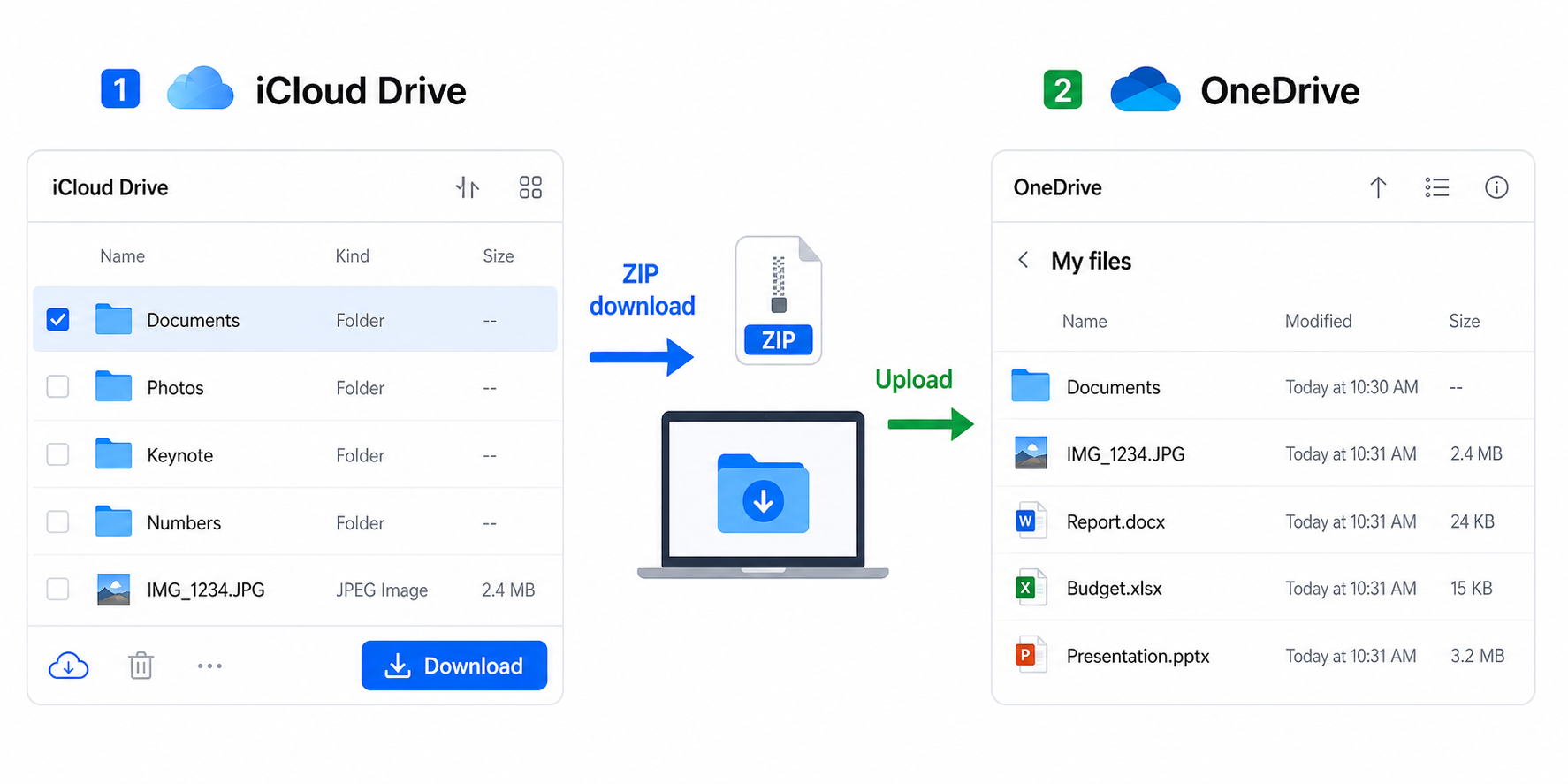
Step 1: Download Files from iCloud Drive
Open iCloud.com
and sign in with your Apple ID. Select the files or folders to move—hold Command on Mac or
Ctrl on Windows to choose several—then click the download icon. Folders come down as ZIP
files, so unzip them locally first.
Step 2: Upload to OneDrive
Go to onedrive.live.com, sign in with your Microsoft account, and use Upload → Files or Folder, or drag items into the window. Rebuild your folder layout as you go to keep documents organized.
The browser route needs no installation, which suits a small batch of files. Both the download and the upload run through your local connection, so a large library will be slow and bandwidth-heavy.
Method 2: Move Files Using Desktop Apps
Step 1: Open Your iCloud Drive Folder
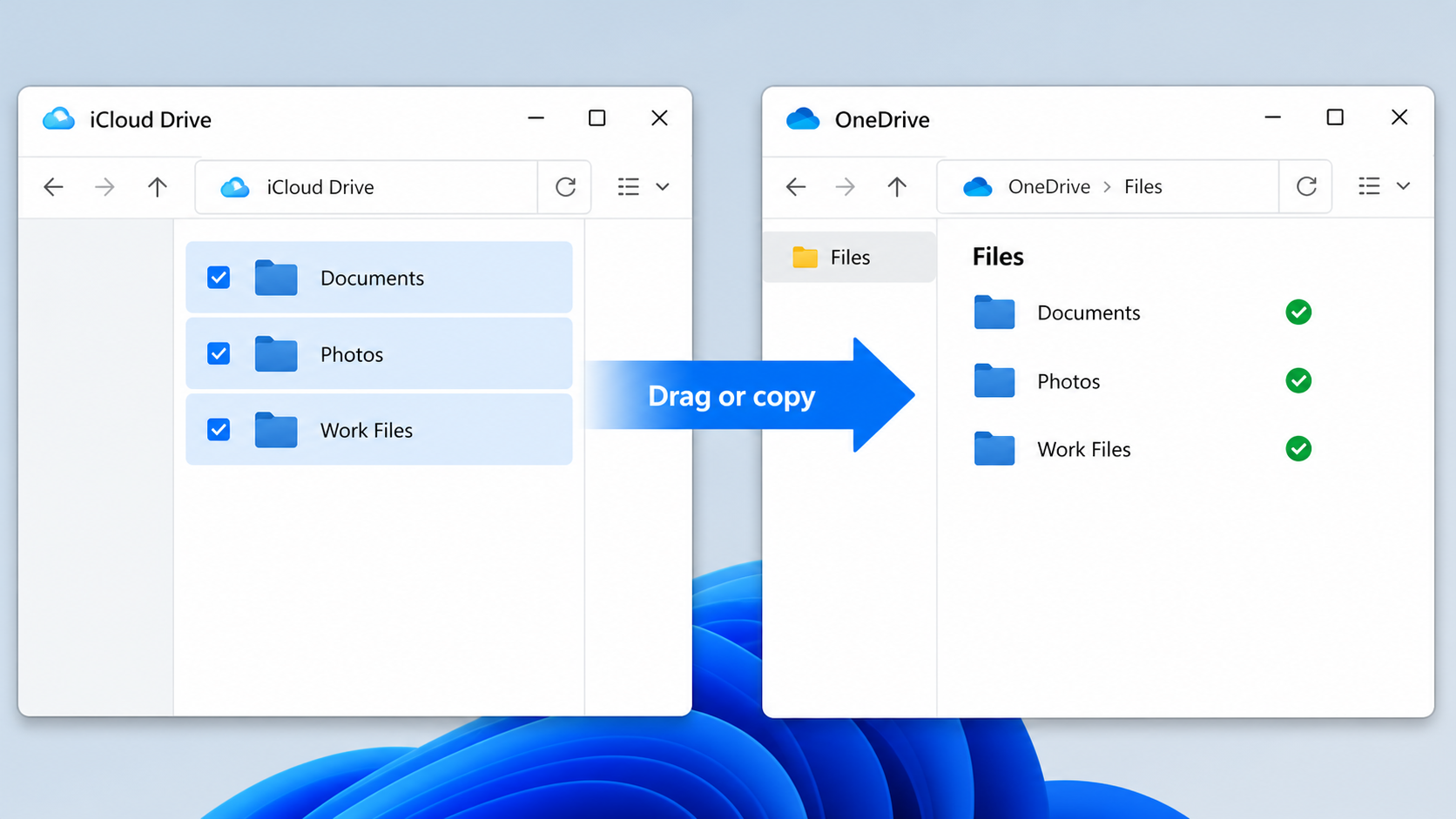
On a Mac, iCloud Drive sits in the Finder sidebar. On Windows, install iCloud for Windows to add the same folder to File Explorer. Confirm the files are downloaded locally, not online-only placeholders, before continuing.
Step 2: Copy into the OneDrive Folder
OneDrive is built into Windows and also runs on macOS through the OneDrive app. Drag files from the iCloud Drive folder into the OneDrive folder, and they sync up to the cloud in the background. On Windows, both folders sit side by side in File Explorer, which makes this a simple drag.
This works well if you already keep both clouds synced on one computer. It still pulls data down from iCloud and pushes it back up to OneDrive, so plan for disk space and time that scale with the library.
Method 3: Command-Line Transfer with Rclone
Step 1: Configure Both Remotes
Rclone connects to both
iCloud Drive and
OneDrive. Run
rclone config and create two remotes: one with the iclouddrive backend (Apple ID
plus a two-factor code) and one with the onedrive backend (Microsoft OAuth in the browser).
Step 2: Run the Copy
With both remotes set, copy a folder directly:
rclone copy icloud:/Documents onedrive:/Documents --progress
Add --dry-run to preview first, or use sync instead of copy to make
the destination mirror the source exactly.
Rclone is well suited to repeat or scripted transfers and supports filters and scheduling. Generating the iCloud token takes some patience, and the data passes through whatever machine runs rclone unless you host it on a server.
Method 4: Direct Cloud-to-Cloud Transfer with CloudsLinker
Cloud-to-Cloud Transfer Without Local Downloads
CloudsLinker moves files directly between Apple's and Microsoft's servers. Data does not pass through your device, and the job continues even if you close the browser.
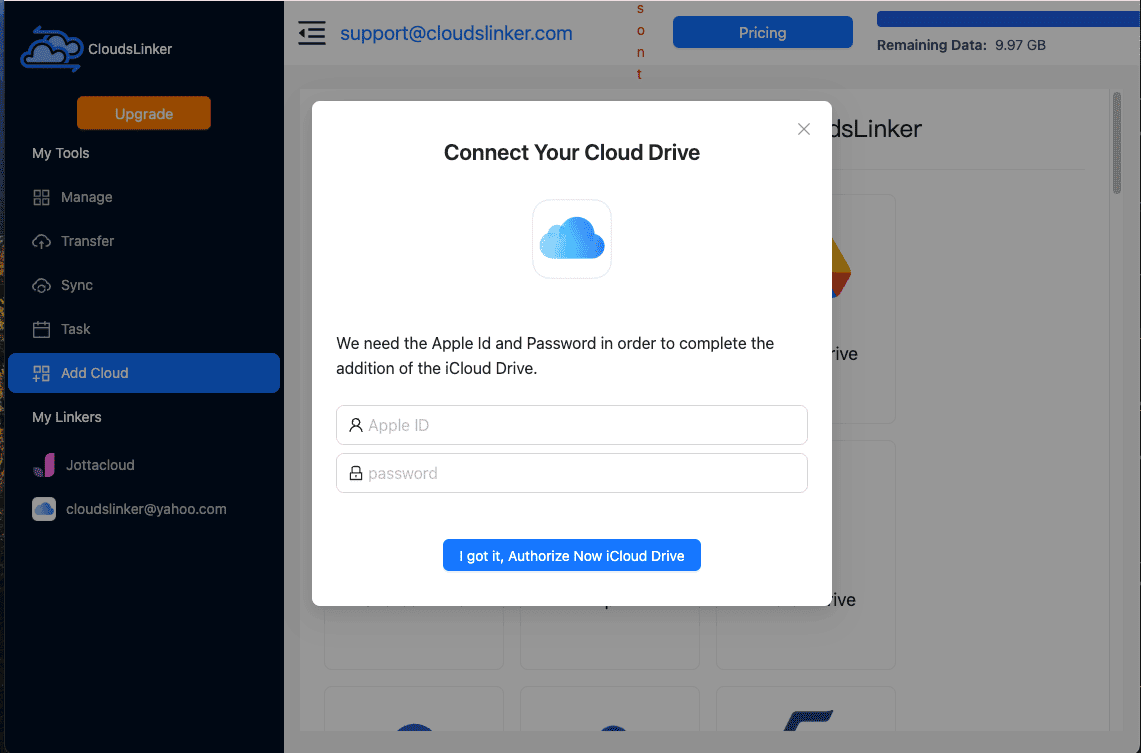
Step 1: Connect iCloud Drive
At app.cloudslinker.com, click Add Cloud and choose iCloud Drive. Enter your Apple ID and password, then the six-digit code from a trusted Apple device. Enable Access iCloud Data on the Web in your Apple ID settings first, or the connection cannot read your files.
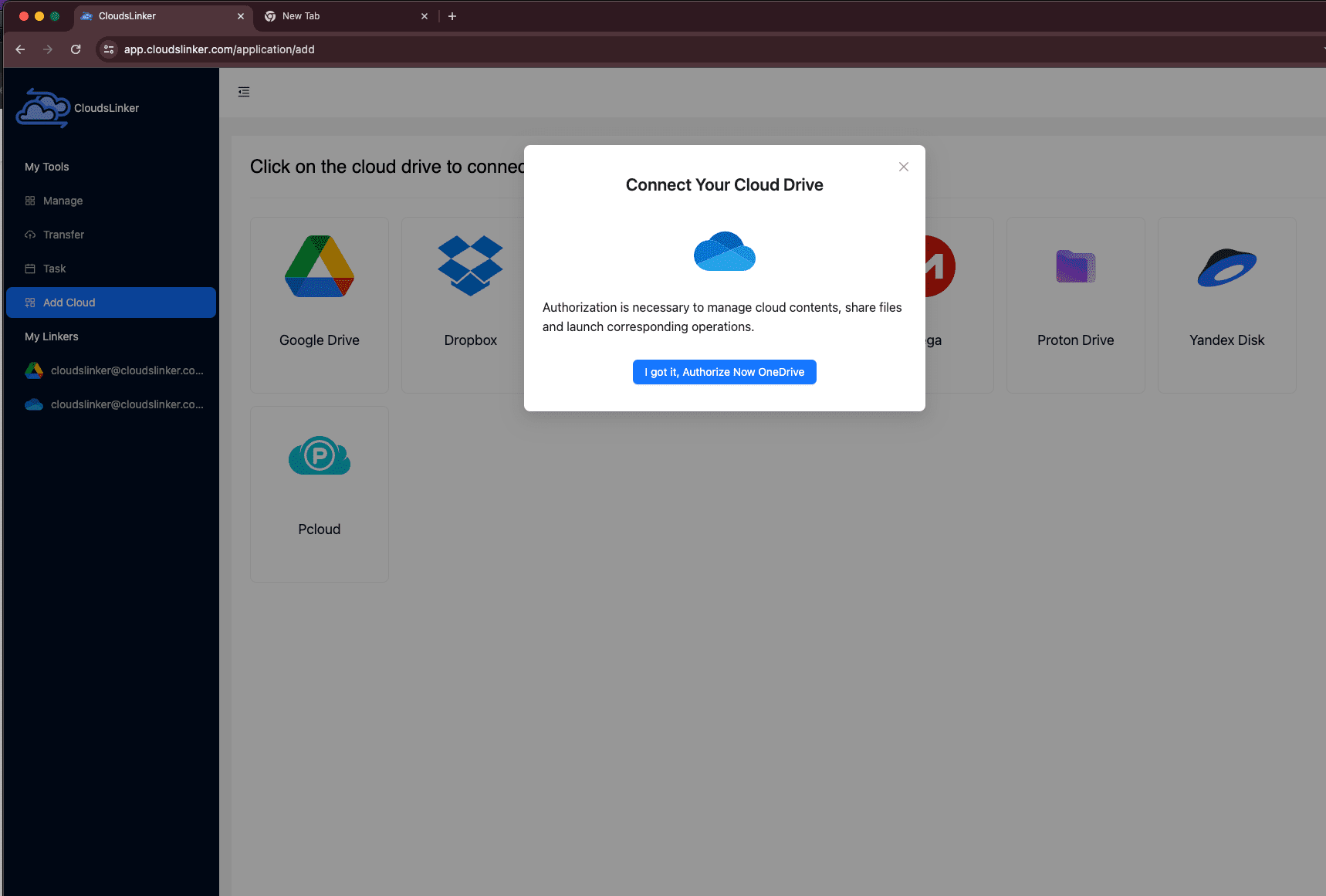
Step 2: Connect OneDrive
Choose OneDrive from the list. CloudsLinker redirects to Microsoft's sign-in page, where you approve access. If your account has more than one drive—say a personal OneDrive plus a OneDrive for Business resource—select the one you want to use. No password is stored, only a revocable token.
Step 3: Configure the Transfer
Open the Transfer tab. Pick iCloud Drive as the source and select the files or folders to move; choose OneDrive as the destination and the target folder. Optional filters limit the job by file type or date, and you can pick Copy (keep originals) or Move (remove them after a successful transfer).
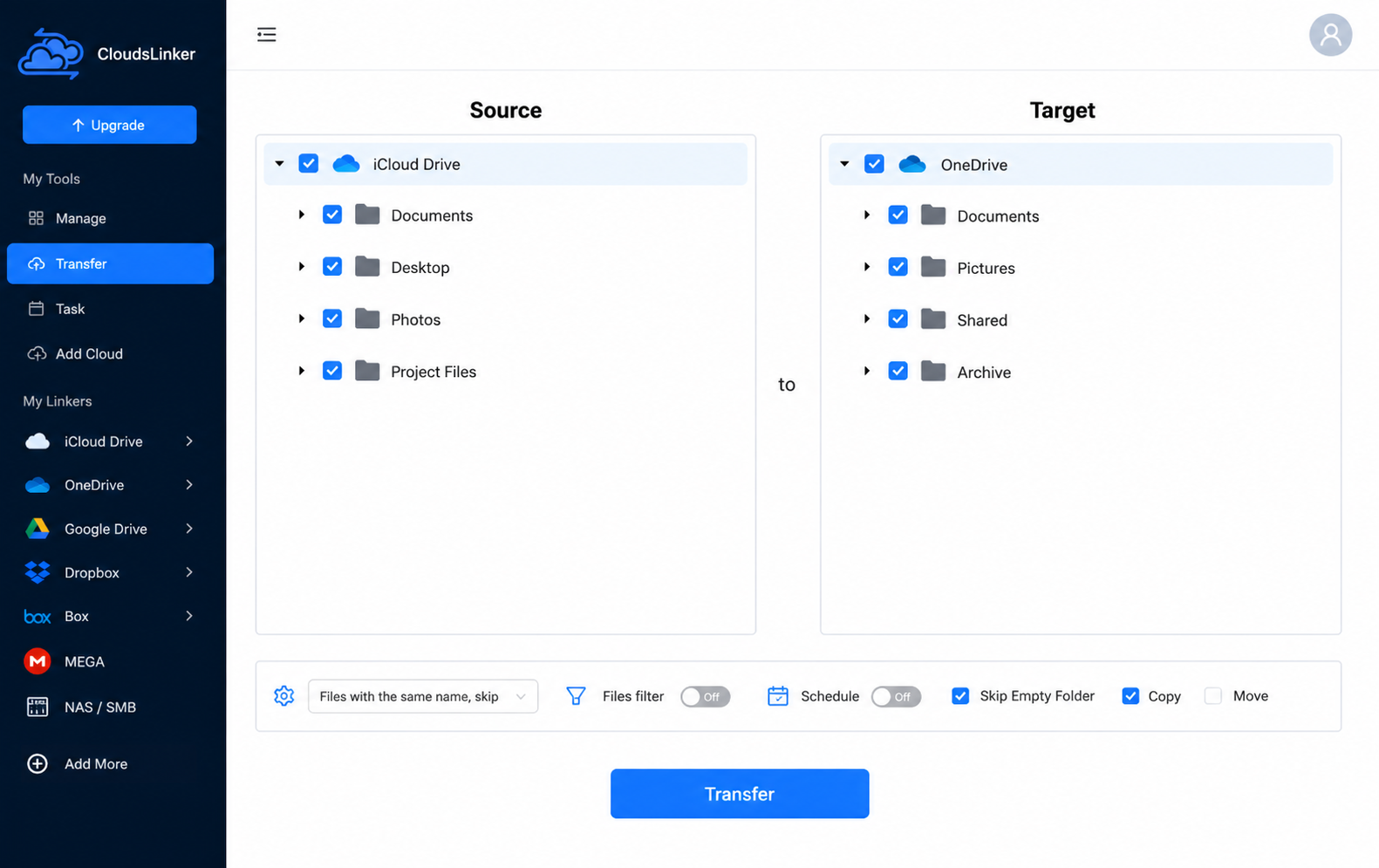
Step 4: Start and Monitor the Transfer
Start the job and watch it from the Task List, which reports transferred size, speed, and remaining items. The transfer runs in the cloud, so you can close the tab or shut down your computer while it finishes and check the report later.
Moving Between Other Clouds?
CloudsLinker also connects Google Drive, Dropbox, Box, MEGA, and S3-compatible storage for direct transfers that skip local downloads. The source and destination can be any supported pair.
Comparing the Ways to Transfer From iCloud Drive to OneDrive
No single method wins for everyone. The choice depends on how much data you move, whether you want command-line control, and how much you care about local bandwidth. This breakdown helps you decide:
| Method | Ease of Use | Speed | Best For | Uses Local Bandwidth | Skill Level |
|---|---|---|---|---|---|
| Web Browser (Manual) | ★★★★★ | ★★★☆☆ | Small, one-time transfers | Yes | Beginner |
| Desktop Apps | ★★★★☆ | ★★★☆☆ | Files already synced locally | Yes | Beginner–Intermediate |
| Rclone (CLI) | ★★☆☆☆ | ★★★★★ | Scripted or repeat transfers | Yes / No (if run on a server) | Advanced |
| CloudsLinker (Cloud) | ★★★★★ | ★★★★★ | Large libraries, no local bandwidth | No | Beginner |
For a few documents, the browser or desktop apps are enough. Rclone gives scripted control at the cost of setup. For a large library or to keep the move off your own device, CloudsLinker runs everything in the cloud.
- Enable web access first: Turn on "Access iCloud Data on the Web" in Apple ID settings, or the browser method and CloudsLinker cannot see your iCloud Drive.
- Download placeholders on Mac: With "Optimize Mac Storage," some files are stubs. Right-click → Download Now before any manual transfer.
- Match your OneDrive plan: Free OneDrive is 5 GB. Confirm a Microsoft 365 plan with enough room before a large move.
- Apple formats vs Office: .pages, .numbers, and .key files transfer intact but won't open in Office. Export them to Word, Excel, or PowerPoint formats if you need to edit in Microsoft 365.
-
Check naming rules: OneDrive blocks a few characters (such as
" * : < > ? / \ |) and some reserved names. Rename affected files before transferring to avoid skipped items. - Copy before move: Run the first transfer in Copy mode and verify files in OneDrive before deleting anything from iCloud.
- Large libraries: For hundreds of gigabytes, a cloud-side transfer avoids tying your device and connection to the job for hours.
Frequently Asked Questions
Conclusion
Pick the method that matches the size of the move. A few documents transfer fine by downloading from iCloud.com and uploading to OneDrive in a browser. If both clouds already sync to your PC, the desktop route reuses what's there. Rclone fits scripted or repeat jobs for anyone comfortable in a terminal. For a large library, or to keep the transfer off your own device and connection, CloudsLinker runs the move directly between Apple's and Microsoft's servers and finishes on its own. Choose based on volume and how hands-on you want to be.
Online Storage Services Supported by CloudsLinker
Transfer data between over 60 cloud services with CloudsLinker

OneDrive

Google Drive

Google Photos

Google Takeout

Shared Drive

OneDrive for Business

Dropbox

Box

Mega

pCloud

Yandex

ProtonDrive

AWS

GCS

iDrive

Storj

DigitalOcean

Wasabi

1fichier

PikPak

TeleBox

OpenDrive

Backblaze B2

Fastmail file

SharePoint

Nextcloud

ownCloud

Premiumize me

HiDrive

Put.io

Sugar Sync

SmugMug

Jottacloud

Seafile

Ftp

SFtp

NAS

WebDav

4shared

Icedrive

Cloudflare R2

Scaleway

Hetzner Object Storage

Synology C2 Object Storage

S3 Compatible

Doi

iCloud Drive

iCloud Photos

FileLU

Zoho WorkDrive

Telia Cloud / Sky

Drime

Filen

TeraBox

Internxt

Degoo

Gofile

Pixeldrain

Shade

Koofr
Didn' t find your cloud service? Be free to contact: [email protected]
Further Reading
Effortless FTP connect to google drive: Transfer Files in 3 Easy Ways
Learn More >
Google Photos to OneDrive: 3 Innovative Transfer Strategies
Learn More >
Google Photos to Proton Drive: 3 Effective Transfer Techniques
Learn More >