iCloud Photos to Filen: Zero-Knowledge Encryption for a Personal Photo Archive
Move iCloud Photos to Filen for end-to-end encrypted storage. Covers iCloud.com export, macOS Photos export, and a cloud-to-cloud transfer via CloudsLinker.
Introduction
Filen applies client-side encryption before any byte leaves the device, which leaves the service itself with no ability to inspect photos at rest. That model appeals to iCloud Photos users who want an archive that stays private even if the provider is compelled to hand over data. iCloud Photos handles sync and device-wide browsing well, but exporting a full library — with HEIC, Live Photos pairs, and RAW originals intact — is a manual operation by design. Three practical paths cover the common scenarios: an iCloud.com download for smaller selections, a macOS Photos export for full format control, and a cloud-to-cloud transfer through CloudsLinker when the library is too large to route through a local disk.
iCloud Photos keeps the Photos library on iPhone, iPad, and Mac synced through Apple's cloud. Originals live in the cloud while each device holds full or optimized copies, depending on local storage.
- Format support: HEIC, Live Photos, RAW, and video alongside JPEG.
- Optimize Storage: local copies can be reduced while originals stay in iCloud.
- Albums and Memories: library organization tied to Apple apps.
- Shared Albums: capacity-limited albums for other Apple users.
- Plans: 5 GB free, paid iCloud+ tiers up to 12 TB.
Filen is an end-to-end encrypted cloud storage service based in Germany. Files are encrypted on the client before upload, which means the service stores only ciphertext and cannot read file contents.
- Zero-knowledge architecture: keys never leave the client.
- Folder-based storage: no Photos-style album or Memories feature.
- Format agnostic: HEIC, RAW, video, and paired Live Photos files are stored as-is.
- 2FA support: required for API access used by migration tools.
- Plans: 10 GB free tier, paid plans up to multi-terabyte.
The two services are shaped by different priorities. iCloud Photos optimizes for a device-wide library experience; Filen optimizes for private, format-neutral storage with no provider-side access to content.
| Feature | iCloud Photos | Filen |
|---|---|---|
| Data model | Photo library with albums, Memories, and faces | Plain files and folders |
| Encryption | Server-side by default; end-to-end only with Advanced Data Protection | End-to-end by default; keys held on the client |
| Data residency | Global Apple infrastructure | Germany, EU data centers |
| Format preservation | Native HEIC, Live Photos, RAW | Stores any file format unchanged |
| Best-fit use case | Everyday photo capture on Apple devices | Long-term encrypted archive of originals |
On the iCloud side
- Check library size: open Settings → Apple ID → iCloud to see total storage used by Photos.
- Turn off Optimize Storage on Mac if planning to export through the Photos app, so originals are present locally before export.
- Decide HEIC or JPEG: iCloud.com's Unmodified Original keeps HEIC; Most Compatible converts to JPEG. The Photos app gives finer control.
- Empty Recently Deleted if any sensitive items remain there; those are not exported but still consume quota.
- Confirm web access: open Apple Account settings and make sure Access iCloud Data on the Web is enabled — required for the CloudsLinker method.
On the Filen side
- Check storage plan: verify the account has enough space for the full library, with a buffer for paired Live Photos files.
- Enable 2FA: required for CloudsLinker to connect. Use an authenticator app and save the recovery key somewhere safe.
- Record the master password and recovery key: Filen is zero-knowledge, so a lost password means a lost archive.
- Plan folder structure: Filen has no albums — decide whether to mirror iCloud albums as folders or organize by year/month.
Method 1: Export from iCloud.com and Upload to Filen
Step 1: Download Photos from iCloud.com
Open iCloud.com/photos
and sign in with your Apple ID. Use the All Photos or Albums view to select items. Hold
Shift to select a range or Cmd/Ctrl to pick specific items,
then click the download icon at the top right.
iCloud prompts for a format: Unmodified Original keeps HEIC, Live Photos, and RAW as captured, while Most Compatible converts to JPEG and H.264. Large selections come down as a ZIP archive.
Step 2: Extract and Sort Locally
Unzip the archive. iCloud exports photos into a flat structure — album grouping is not preserved. If album layout matters, download albums one at a time and mirror the structure locally before upload.
Step 3: Upload to Filen
Open the Filen web app, sign in, and navigate to the target folder. Drag the extracted files in. Encryption happens on the client before upload, so the initial upload speed depends on local CPU as well as bandwidth. Uploads resume if the browser tab reconnects after a drop.
Method 2: macOS Photos App Export Bridge
Best for keeping HEIC, Live Photos, and RAW originals intact
The Mac Photos app offers finer export control than the web client. It preserves original formats, respects album organization, and optionally embeds capture metadata. The trade-off: the full library has to be present on disk first.
Step 1: Download Originals to Your Mac
Open Photos on Mac. Go to Settings → iCloud and switch to Download Originals to this Mac. Wait for the library to sync fully. For multi-hundred-gigabyte libraries, this can take most of a day and requires enough free disk space to hold every original.
Step 2: Export from Photos
Select photos or whole albums. Go to File → Export → Export Unmodified Originals.
This preserves HEIC, Live Photos pairs (.HEIC + .MOV), RAW, and capture timestamps. Point the
export at a folder outside ~/Pictures so Photos does not rescan the output.
For broad compatibility, use File → Export X Photos instead and pick JPEG as the format. That path also controls IPTC metadata and sidecar files.
Step 3: Upload to Filen
Install the Filen desktop client or use the web app. Drag the exported folders into the Filen target directory. If Export Unmodified Originals was used, the paired .HEIC and .MOV files for Live Photos should stay in the same Filen folder — Filen does not re-pair them, so filename proximity is what preserves the pairing.
Method 3: Cloud-to-Cloud Transfer with CloudsLinker
Move the Library Without Routing Through a Local Disk
CloudsLinker connects iCloud Photos and Filen directly. Photos move between cloud servers, so a multi-hundred-gigabyte library does not need to be staged locally. The transfer continues after the browser is closed.
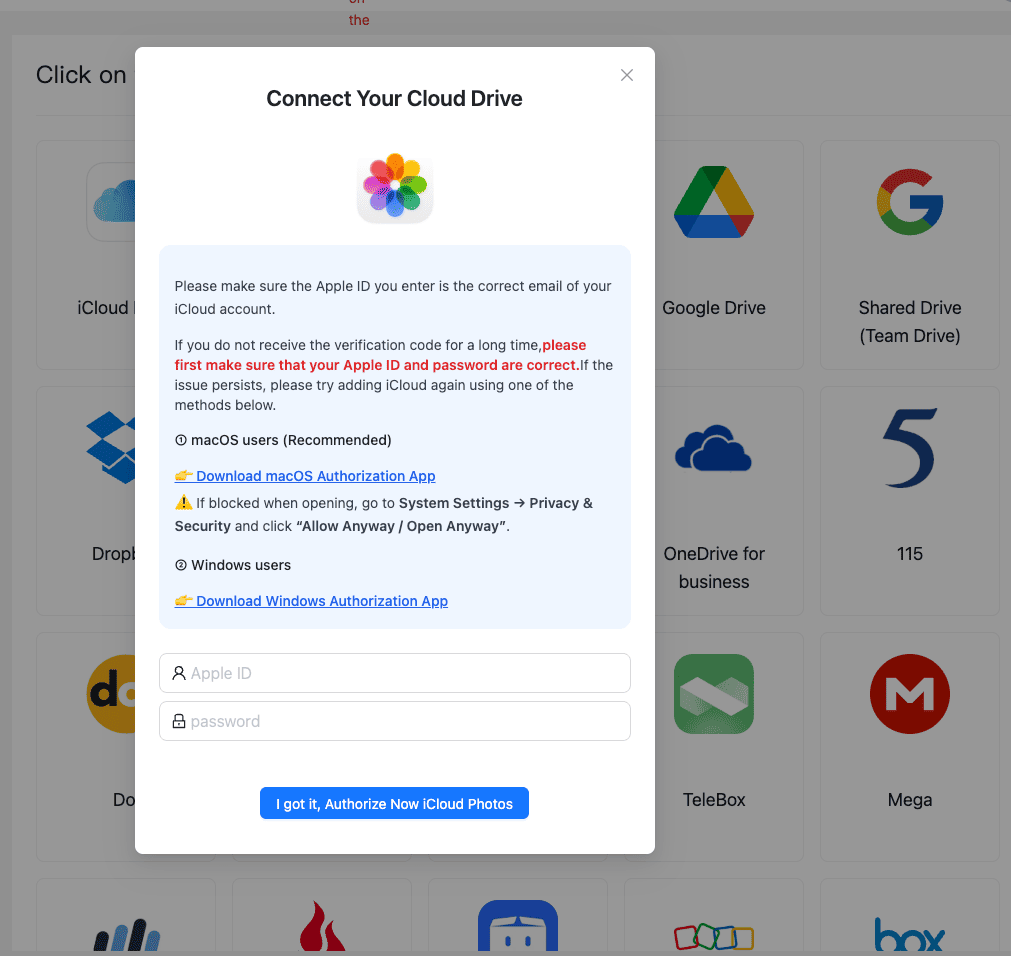
Step 1: Connect iCloud Photos
In CloudsLinker, click Add Cloud and choose iCloud Photos. Enter the Apple ID, password, and the 6-digit verification code from a trusted Apple device. The switch Access iCloud Data on the Web must be enabled in Apple Account settings — without it the connection cannot enumerate the library.
Step 2: Connect Filen
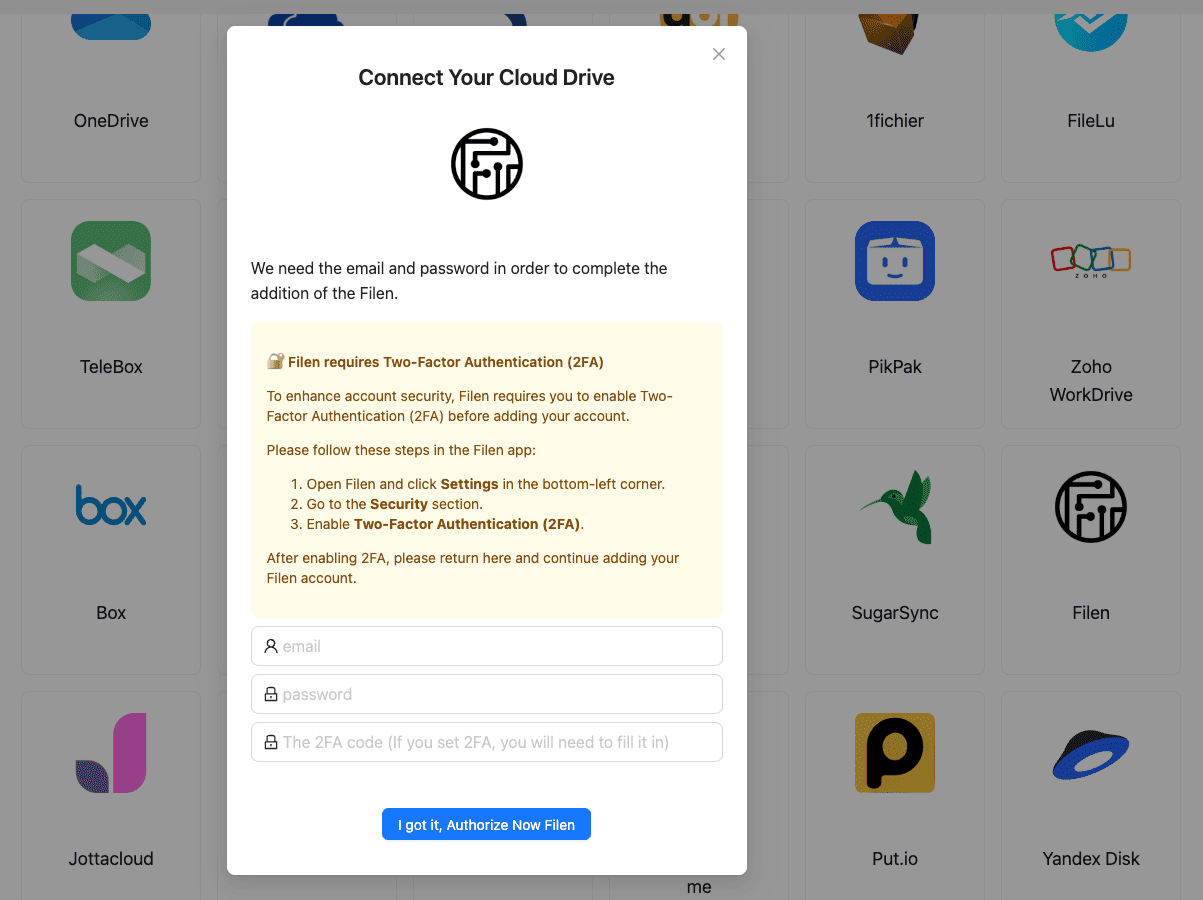
Click Add Cloud again and select Filen. Enter the Filen account email and master password, then the 2FA code from the authenticator app. Once authenticated, Filen shows up as a connected destination. Keep in mind that CloudsLinker never sees the master password in plaintext beyond the login request — file content remains encrypted end-to-end on the Filen side.
Step 3: Configure the Transfer
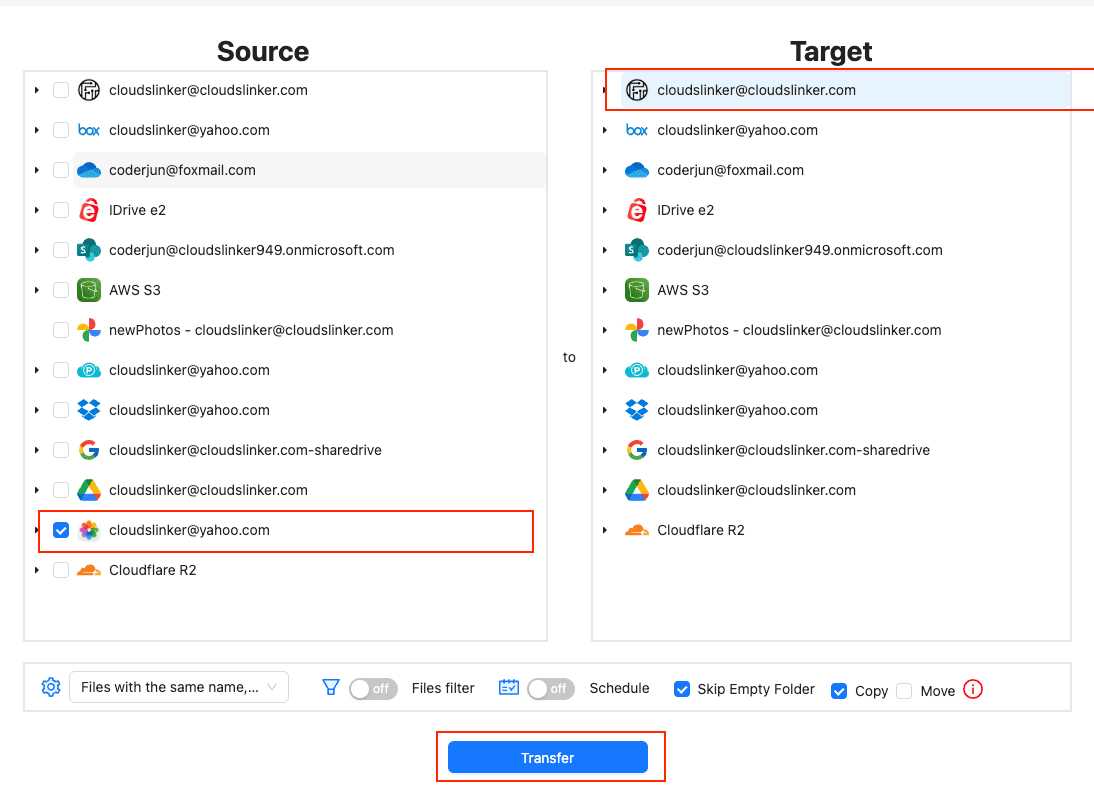
Open the Transfer section. Pick iCloud Photos as the source and browse the library — the entire library or a specific album can be selected. On the destination side, select the Filen folder where photos should land.
Apply filters if useful: limit by capture date, skip videos, or include only RAW files. Pick Copy to leave the iCloud library untouched until the destination has been verified.
Step 4: Start and Monitor
Start the task. The Task List shows transferred size, current speed, and remaining items. The job runs entirely on CloudsLinker servers, so closing the browser does not interrupt it. Once it completes, open the Filen web app and spot-check a few albums before removing anything from iCloud.
Comparing the Ways to Transfer From iCloud Photos to Filen
| Method | Ease of Use | Speed | Best For | Uses Local Bandwidth | Skill Level |
|---|---|---|---|---|---|
| iCloud.com Export | ★★★★☆ | ★★☆☆☆ | Small selections, any OS | Yes | Beginner |
| macOS Photos Export | ★★★☆☆ | ★★★☆☆ | Mac users keeping HEIC/RAW originals | Yes | Intermediate |
| CloudsLinker | ★★★★★ | ★★★★★ | Large libraries, Windows users, hands-off moves | No | Beginner |
- Save the Filen recovery key before starting: end-to-end encryption means the service cannot reset a lost password. Store the recovery key in a password manager or an offline location.
- Keep Live Photos pairs together: a Live Photo is a .HEIC image plus a .MOV clip. Upload both files into the same Filen folder so the pairing can be restored if the library is ever re-imported into an Apple device.
- Verify RAW file sizes: after transfer, sample a few RAW files in Filen and confirm file sizes are close to the originals. A much smaller size indicates that the JPEG sidecar was uploaded instead of the RAW.
- Albums need to become folders: Filen has no Photos-style album view. Decide up front whether to replicate album names as folder names or consolidate by year and month.
- Watch for Advanced Data Protection: iCloud accounts using ADP may require extra confirmation for web data access. CloudsLinker uses Apple's authorized web flow, so a working ADP configuration usually just works after the initial prompt.
- Run a test album first: transfer one album of modest size, open a handful of photos in Filen, and only then start the full library.
Frequently Asked Questions
/Photos/2024/2024-08 Italy Trip, or recreate album names as folders.
Conclusion
Short answer by scenario: a few hundred photos go fastest through iCloud.com, Mac users with disk space to spare get the cleanest originals from the Photos app, and anything beyond a few tens of gigabytes is best handled server-side through CloudsLinker. Filen's zero-knowledge model means the provider cannot help recover a lost password, so confirm the account recovery key is stored safely before migrating. Always transfer one album as a test, verify the files open correctly in Filen, and keep the iCloud copy until the migration has been checked end to end.
Online Storage Services Supported by CloudsLinker
Transfer data between over 58 cloud services with CloudsLinker

OneDrive

Google Drive

Google Photos

Shared Drive

OneDrive for Business

Dropbox

Box

Mega

pCloud

Yandex

ProtonDrive

AWS

GCS

iDrive

Storj

DigitalOcean

Wasabi

1fichier

PikPak

TeleBox

OpenDrive

Backblaze B2

Fastmail file

SharePoint

Nextcloud

ownCloud

Premiumize me

HiDrive

Put.io

Sugar Sync

Jottacloud

Seafile

Ftp

SFtp

NAS

WebDav

4shared

Icedrive

Cloudflare R2

Scaleway

Hetzner Object Storage

Synology C2 Object Storage

S3 Compatible

Doi

iCloud Drive

iCloud Photos

FileLU

Zoho WorkDrive

Telia Cloud / Sky

Drime

Filen

TeraBox

Internxt

Degoo

Gofile

Pixeldrain

Shade

Koofr
Didn' t find your cloud service? Be free to contact: [email protected]
Further Reading
Effortless FTP connect to google drive: Transfer Files in 3 Easy Ways
Learn More >
Google Photos to OneDrive: 3 Innovative Transfer Strategies
Learn More >
Google Photos to Proton Drive: 3 Effective Transfer Techniques
Learn More >