TeraBox to Dropbox: Trade Free Capacity for Sync That Just Works
Move TeraBox files to Dropbox for reliable block-level sync, broad app integrations, and granular share links. Browser, desktop sync, or CloudsLinker.
Introduction
Dropbox built its reputation on sync that rarely breaks — block-level updates that send only the changed part of a file, a desktop client that resolves conflicts cleanly, and link sharing with expiry and password controls. TeraBox, by contrast, is a storage locker: large and free, but with one-file-at-a-time downloads, no real sync engine, and minimal sharing controls. Anyone who keeps active project files moving between devices feels that gap quickly. Moving those files to Dropbox restores dependable sync and the long list of third-party integrations that connect to it. TeraBox exposes no OAuth API, so every export route runs through its browser cookie. This guide walks through a browser download, the Dropbox desktop client as a bridge, and a cloud-to-cloud transfer with CloudsLinker.
TeraBox is a consumer file locker from Flextech Inc. Its 1 TB free tier is the headline; the absence of a true sync engine and granular sharing is the trade-off.
- Free quota: 1 TB advertised; ~80 GB practical (20-file cap).
- Sync: basic upload/download; no block-level delta sync.
- Sharing: link sharing; limited controls on free.
- Per-file cap: 4 GB free / 20 GB Premium.
- Access: browser cookie (
ndus,ndut_fmt); no OAuth.
Dropbox is a file-sync service known for reliability and a deep integration ecosystem. The free Basic plan offers 2 GB; paid plans start at 2 TB.
- Block-level sync: transfers only the changed parts of a file.
- Smart Sync / selective sync: choose what stays local.
- Sharing controls: expiring links, passwords, view/edit permissions.
- Integrations: broad third-party app support.
- Access: OAuth for third-party tools.
The two services target different needs. TeraBox is cheap bulk storage; Dropbox is a sync and collaboration tool with a smaller but full-speed free tier. The contrast is sharpest around how files move and how they are shared.
| Feature | TeraBox | Dropbox |
|---|---|---|
| Free quota | 1 TB advertised; ~80 GB practical | 2 GB (Basic) |
| Sync engine | Basic upload/download | Block-level delta sync |
| Download speed (free) | ~100–531 KB/s, one file at a time | Full speed, concurrent |
| Share controls | Basic links | Expiry, password, view/edit roles |
| Third-party access | Browser cookie only | OAuth 2.0 |
On the TeraBox side
- Identify your active files: the project files you sync across devices are the ones that benefit most from Dropbox.
- Keep the session current: the cookie must be live for any method to work.
- List shared TeraBox links: they stop working after files move, so plan to reissue the ones that matter using Dropbox's controls.
On the Dropbox side
- Mind the 2 GB free tier: a large TeraBox library will need a paid Dropbox plan (2 TB+). Confirm capacity first.
- Create a target folder such as
/TeraBox-Import/. - Plan selective sync so the import does not force every file onto each device.
Method 1: Browser Download from TeraBox, Upload to Dropbox
Step 1: Download from TeraBox
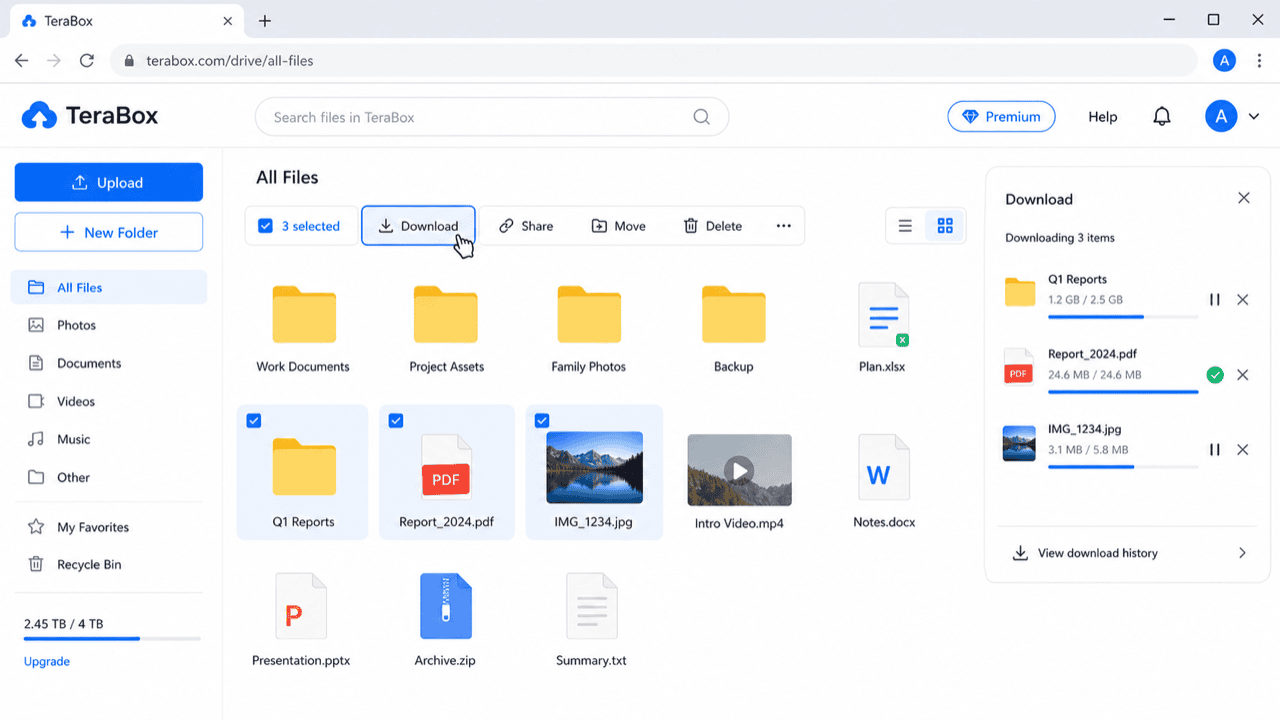
Sign in at terabox.com and download the files you want. Free-tier downloads are serialized, so prioritize active project files and split large folders into batches.
Step 2: Upload to Dropbox
Open dropbox.com, open your target folder, and drag the files in — or use Upload → Folder. Dropbox uploads at full speed, and from that point the files sync to every device on the account.
Method 2: Dropbox Desktop Client as a Bridge
Best if you already sync with the Dropbox app
Download from TeraBox straight into your local Dropbox folder; the client uploads and then keeps the files in sync. Selective sync controls what stays on each device afterward.
Step 1: Download into the Dropbox Folder
With the TeraBox desktop app or browser, download into a subfolder of your local Dropbox
directory (for example, Dropbox/TeraBox-Import/). The Dropbox client begins
uploading right away.
Step 2: Confirm Sync and Set Selective Sync
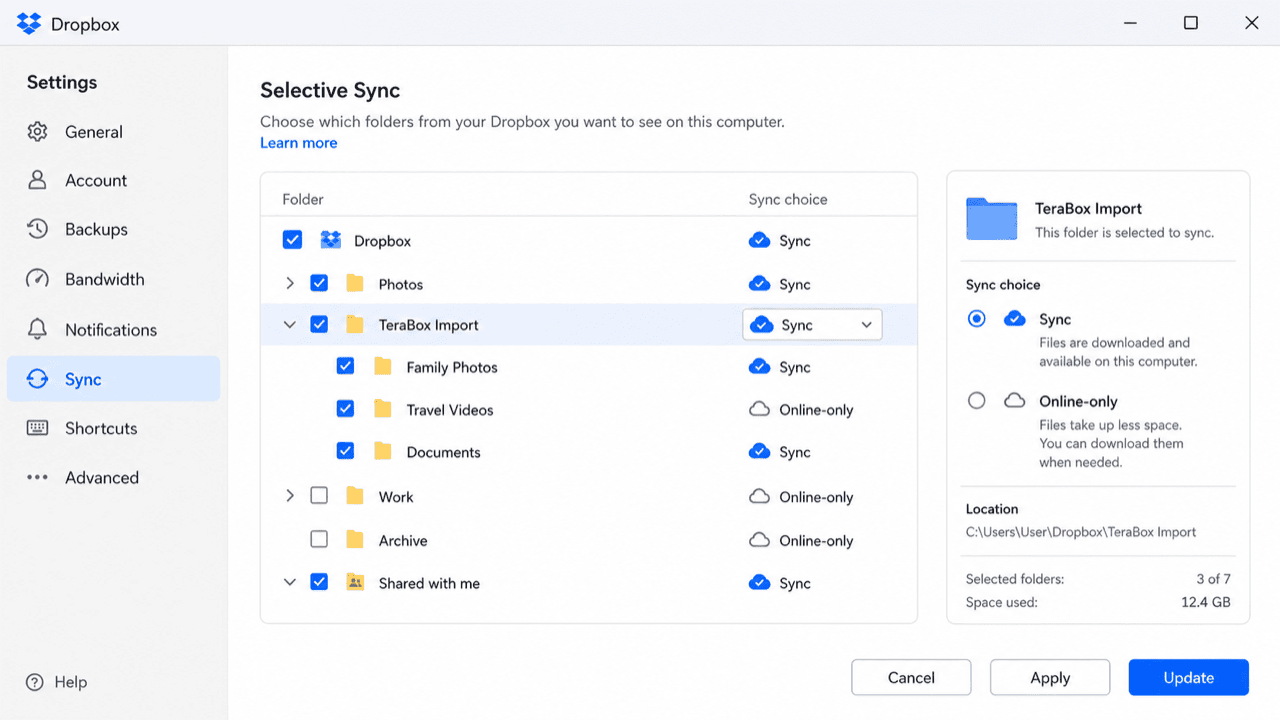
Wait for the green sync check. Then open Dropbox preferences and use Selective Sync to keep large archive folders cloud-only on devices that do not need them locally — useful when the import is bigger than a laptop's drive.
Method 3: Cloud-to-Cloud Transfer with CloudsLinker
Move It Server-Side, Then Let Dropbox Sync Take Over
CloudsLinker reads from TeraBox by cookie and writes into Dropbox over OAuth, running server-side and retrying through TeraBox's throttle. Once files are in Dropbox, its sync engine distributes them to your devices.
Step 1: Connect TeraBox (Browser Cookie)
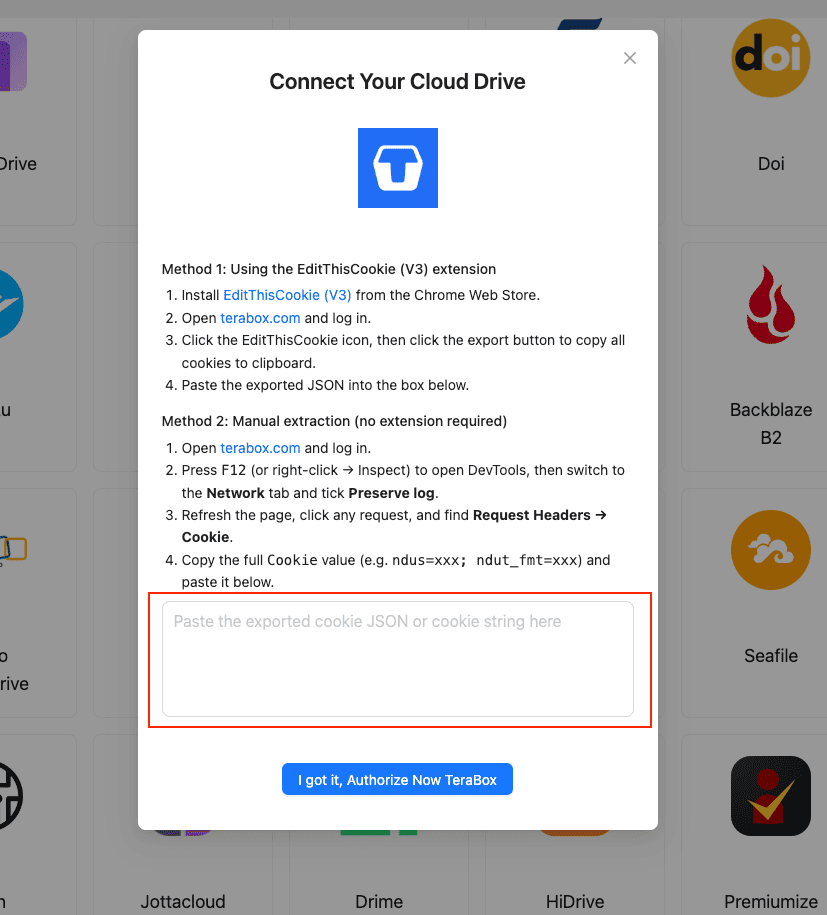
In CloudsLinker, click Add Cloud → TeraBox and provide the session cookie:
- Install EditThisCookie (V3) in Chrome.
- Open
www.terabox.comin the same browser, signed in. - Click EditThisCookie → Export to copy the cookie JSON.
- Paste it into CloudsLinker and confirm.
Or copy the Cookie header (ndus=...; ndut_fmt=...) from DevTools
(F12) → Network.
Step 2: Connect Dropbox
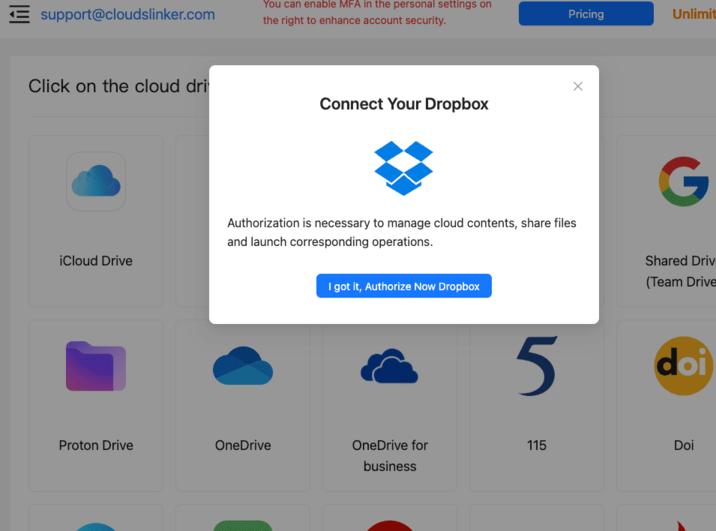
Click Add Cloud → Dropbox and complete the OAuth sign-in. Approve access and Dropbox appears as a connected destination; you can revoke it later from Dropbox's connected-apps settings.
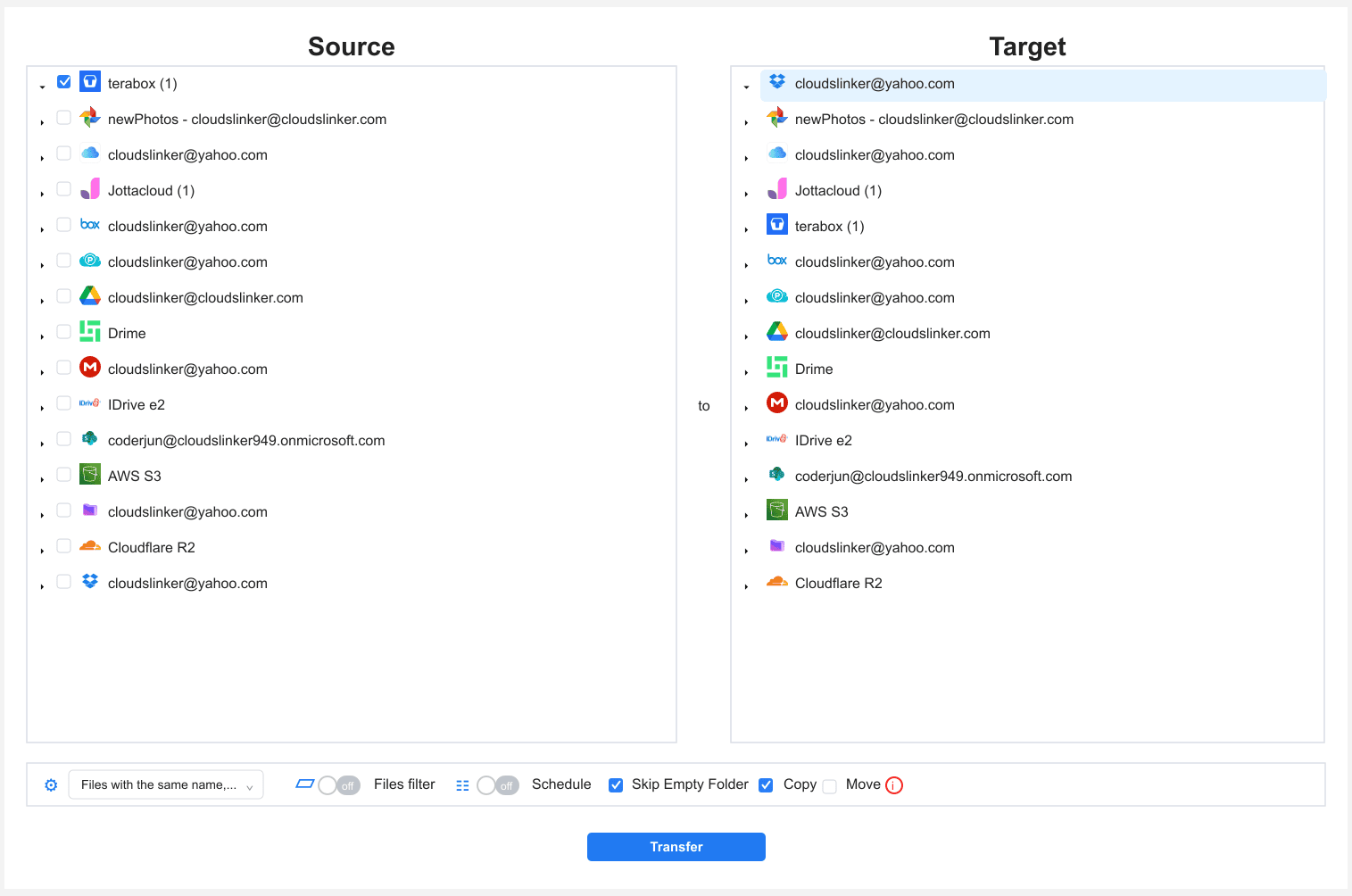
Step 3: Configure the Transfer
In the Transfer section, set TeraBox as the source and
Dropbox as the destination with your /TeraBox-Import/ folder. Filter by
type, size or date. Copy mode keeps TeraBox intact until Dropbox is verified.
Step 4: Start and Monitor
Start the task and track it in the Task List. If the TeraBox cookie expires, the task pauses for a fresh one. After completion, the imported files appear in Dropbox and begin syncing to your connected devices.
Method Comparison
| Method | Ease of Use | Speed | Best For | Uses Local Bandwidth | Skill Level |
|---|---|---|---|---|---|
| Browser Download + Upload | ★★★★☆ | ★★☆☆☆ | A few files, one-off pulls | Yes | Beginner |
| Dropbox Desktop Bridge | ★★★☆☆ | ★★★☆☆ | Existing Dropbox sync users | Yes | Intermediate |
| CloudsLinker | ★★★★★ | ★★★★☆ | Large libraries, hands-off moves | No | Beginner |
- Reissue share links in Dropbox: TeraBox links break when files move. Recreate them with Dropbox's expiry and password controls, which are stronger than TeraBox's.
- Use selective sync for the import: a large TeraBox library can dwarf a laptop SSD. Keep archive folders cloud-only on devices that do not need them.
- Check the 2 GB free ceiling early: Dropbox Basic is small. Confirm a paid plan before moving anything substantial.
- Let block-level sync work after the move: once files are in Dropbox, edits sync only the changed blocks — far more efficient than TeraBox's full re-upload.
- Refresh the cookie before long jobs: re-login to TeraBox right before exporting the cookie for CloudsLinker.
- Verify counts before deleting: compare file counts per folder between TeraBox and Dropbox before clearing the source.
Frequently Asked Questions
ndus, ndut_fmt), since TeraBox
has no OAuth. Dropbox connects through OAuth, revocable from its connected-apps page.
Watch: Transfer Files from TeraBox to Dropbox with CloudsLinker
A walkthrough of the cloud-to-cloud method: pasting the TeraBox cookie, connecting Dropbox via OAuth, selecting the files to move, and monitoring the server-side transfer in the Task List.
Conclusion
For a small set of files, the browser download into Dropbox is fine. If you run the Dropbox desktop app, dropping TeraBox files into your Dropbox folder lets block-level sync and selective sync take over from there. For a large library, CloudsLinker connects TeraBox by cookie and Dropbox by OAuth, moving data server-side and retrying through TeraBox's throttle so the job finishes unattended. The reason to make the move is what happens after: Dropbox keeps the files in sync across every device and exposes them to the integrations TeraBox never supported.
Online Storage Services Supported by CloudsLinker
Transfer data between over 58 cloud services with CloudsLinker

OneDrive

Google Drive

Google Photos

Shared Drive

OneDrive for Business

Dropbox

Box

Mega

pCloud

Yandex

ProtonDrive

AWS

GCS

iDrive

Storj

DigitalOcean

Wasabi

1fichier

PikPak

TeleBox

OpenDrive

Backblaze B2

Fastmail file

SharePoint

Nextcloud

ownCloud

Premiumize me

HiDrive

Put.io

Sugar Sync

Jottacloud

Seafile

Ftp

SFtp

NAS

WebDav

4shared

Icedrive

Cloudflare R2

Scaleway

Hetzner Object Storage

Synology C2 Object Storage

S3 Compatible

Doi

iCloud Drive

iCloud Photos

FileLU

Zoho WorkDrive

Telia Cloud / Sky

Drime

Filen

TeraBox

Internxt

Degoo

Gofile

Pixeldrain

Shade

Koofr
Didn' t find your cloud service? Be free to contact: [email protected]
Further Reading
Effortless FTP connect to google drive: Transfer Files in 3 Easy Ways
Learn More >
Google Photos to OneDrive: 3 Innovative Transfer Strategies
Learn More >
Google Photos to Proton Drive: 3 Effective Transfer Techniques
Learn More >