Backing Up iCloud Photos to MEGA Without Breaking Your Albums
Need a reliable way to move photos from iCloud Photos to MEGA? This guide shares three realistic approaches—from album downloads to direct mobile uploads and automated cloud-to-cloud transfer—based on what actually works in day-to-day use.
Introduction
I didn’t plan to move anything out of iCloud Photos. It happened gradually. My photo library kept growing, and I wanted a second copy somewhere that wasn’t tied to the Apple ecosystem. I’d already been using MEGA for large file storage and encrypted sharing, so it felt like a logical place to keep a backup of my photos too. The tricky part wasn’t storage — it was preserving albums and not turning everything into one giant, messy folder. After trying a few approaches, here are the three methods that actually worked for me.
iCloud Photos isn’t just a storage space — it’s a sync engine. Every picture you take quietly appears across your iPhone, iPad, and Mac without you thinking about it. That convenience is hard to give up.
- 5 GB free shared across backups, mail, files, and photos.
- iCloud+ plans scale up to 12 TB.
- Original quality storage with device optimization options.
- Deep Apple integration — works best inside Apple hardware.
The issue usually shows up quietly. The library grows, storage warnings appear, and suddenly you’re upgrading again.
MEGA feels different from iCloud. It behaves more like a traditional file vault. You log in, see folders, move things around — no hidden database layer.
- Free plan available with limited transfer quota.
- End-to-end encryption by design.
- Cross-platform apps for desktop and mobile.
- Public link sharing with optional password protection.
I originally started using MEGA for sending large RAW files to clients. Later it became my “secondary archive” space. One small limitation to be aware of: MEGA enforces transfer quotas on free accounts, so very large uploads may need to be split or scheduled.
For me, it wasn’t about abandoning Apple. It was about redundancy. Keeping all memories inside a single ecosystem makes me slightly uneasy. MEGA gave me a separate, encrypted location that I already trusted for other files.
There’s also the practical side. If you need to share large folders with people who aren’t using Apple devices, MEGA links are straightforward. No explaining shared albums or Apple IDs.
- Encrypted Storage: A separate copy outside Apple’s ecosystem.
- Large File Sharing: Easy link generation for big folders.
- Cross-Platform Access: Works the same on Windows, macOS, and Linux.
- Backup Redundancy: Reduces single-provider dependency.
The challenge is that iCloud Photos isn’t just a folder you drag somewhere else. So here are the three methods that made sense depending on library size.
Method 1: Download from iCloud Photos, Then Upload to MEGA
This is the most straightforward path. No additional tools — just your browser.
Open iCloud Photos on the web , download the albums you want, then upload them into MEGA .
- No setup required
- Full control over album selection
- Good for small or medium exports

The obvious downside: you download everything once, then upload it again. That doubles bandwidth usage and time.
For 10–30 GB, this is manageable. For 300+ GB, it becomes a weekend project.
I still use this method occasionally when moving specific albums only — not full archives.
Method 2: Upload Directly from Your iPhone Using the MEGA App
If your photos are mainly on your phone, using the mobile app avoids touching a computer.
Install MEGA for iOS , sign in with your MEGA email and password, and upload from your camera roll.
- Open the MEGA app.
- Tap the upload button.
- Select Photos and Videos.
- Choose albums or individual items.

Uploads continue in the background, though iOS may pause long transfers if the app is inactive for too long.
One benefit is selectivity. You can move only certain trips or recent months.
The limitation is speed and quota. Free MEGA accounts have transfer caps, so very large libraries may need patience or a paid plan.
Method 3: Move iCloud Photos to MEGA Directly in the Cloud (No Local Downloads)
When Downloading Everything No Longer Makes Sense
If your library is measured in hundreds of gigabytes, downloading everything locally feels unnecessary. Using CloudsLinker allows direct transfer between iCloud Photos and MEGA, without routing data through your computer.
Step 1: Connect iCloud Photos
Click Add Cloud and select iCloud Photos. Log in with your Apple ID and complete two-factor authentication.

Step 2: Connect MEGA
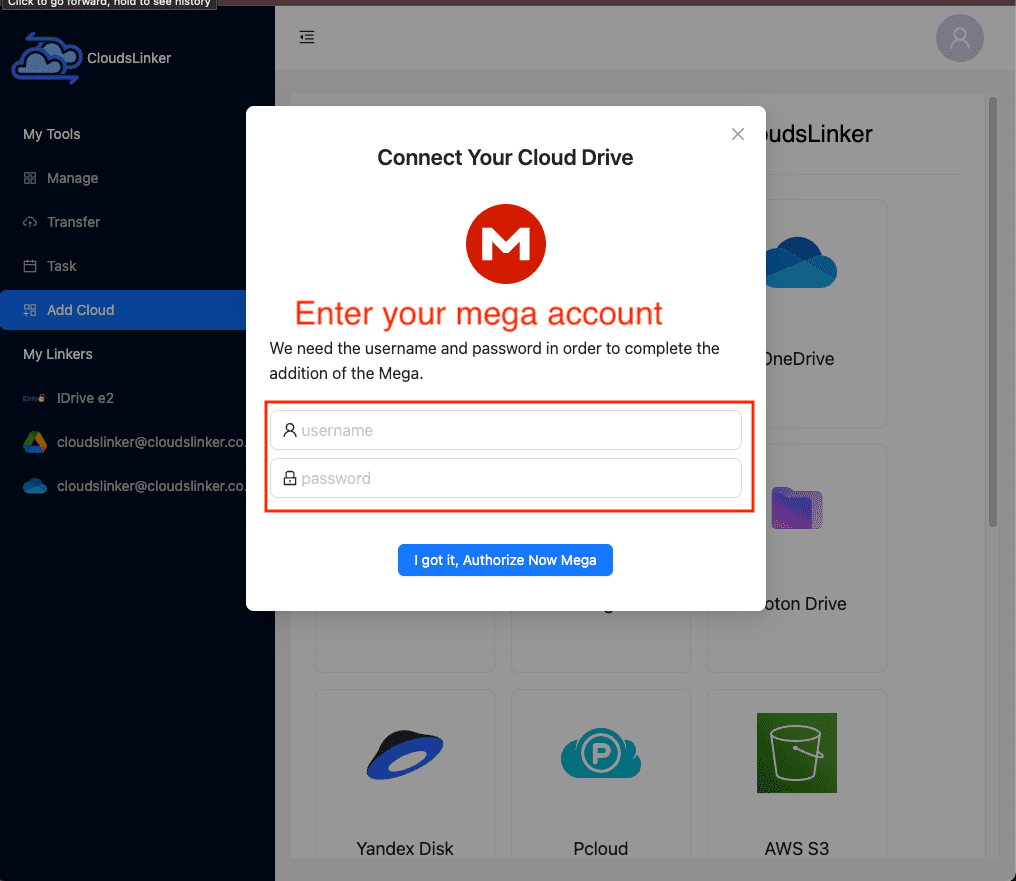
Add MEGA from the cloud list. Unlike Google Drive or OneDrive, MEGA does not use OAuth 2.0. You enter your MEGA email and password directly to establish the encrypted session.
Step 3: Configure the Transfer
Go to the Transfer section. Choose iCloud Photos as the source and MEGA as the destination.

Step 4: Monitor the Progress
The transfer appears in your Task List. Since everything runs in the cloud, your computer can be turned off.
For very large libraries, this avoids tying up your home connection for days.
Comparing the 3 Ways to Move Photos from iCloud Photos to MEGA
There isn’t a single “correct” method. It depends on library size and how much supervision you want. If your goal is redundancy and encrypted backup inside MEGA, reliability usually matters more than raw speed.
| Method | Ease of Use | Speed | Best For | Uses Local Bandwidth | Skill Level |
|---|---|---|---|---|---|
| Web Browser (Download → Upload) | ★★★★★ | ★★★☆☆ | Small exports, selective albums | Yes (download + upload) | Beginner |
| iPhone (MEGA App Upload) | ★★★★★ | ★★☆☆☆ | Recent photos or specific albums | Yes (Wi-Fi/mobile upload) | Beginner |
| CloudsLinker (Cloud-to-Cloud) | ★★★★☆ | ★★★★★ | Large libraries, minimal supervision | No | Beginner |
For a few albums, the browser route is perfectly fine. For entire multi-year libraries, skipping the download-upload cycle usually feels like a relief.
A few small details can save frustration.
- Export album by album: Bulk selection on iCloud web is limited.
- Plan for transfer quotas: Free MEGA accounts have bandwidth caps.
- Watch file formats: HEIC files upload fine, but sharing with non-Apple users may require later conversion.
- Check available space first: Especially if you’re close to MEGA’s storage limits.
- Move in stages: Verify albums before migrating everything.
- Understand login method: MEGA connections require entering your account email and password. It does not use OAuth redirection like Google Drive or OneDrive.
Start small, confirm structure, then expand the transfer.
Frequently Asked Questions
Conclusion
Moving photos from iCloud Photos to MEGA isn’t complicated, but it does take a bit of planning. Smaller exports are fine with manual downloads. If everything is on your phone, uploading directly through the MEGA app works — just expect it to take time. For larger libraries, cloud-to-cloud transfer avoids the download-and-reupload loop entirely. Whichever route you choose, double-check album folders and file counts inside MEGA before considering the job finished.
Online Storage Services Supported by CloudsLinker
Transfer data between over 48 cloud services with CloudsLinker

OneDrive

Google Drive

Google Photos

Shared Drive

OneDrive for Business

Dropbox

Box

Mega

pCloud

Yandex

ProtonDrive

AWS

GCS

iDrive

Storj

DigitalOcean

Wasabi

1fichier

PikPak

TeleBox

OpenDrive

Backblaze B2

Fastmail file
SharePoint

Nextcloud

ownCloud

Premiumize me

HiDrive

Put.io

Sugar Sync

Jottacloud

Seafile

Ftp

SFtp

NAS

WebDav

4shared

Icedrive

Cloudflare R2

Scaleway

Doi

iCloud Drive

iCloud Photos

FileLU

Zoho WorkDrive

Telia Cloud / Sky

Drime

Filen
Didn' t find your cloud service? Be free to contact: [email protected]
Further Reading
Effortless FTP connect to google drive: Transfer Files in 3 Easy Ways
Learn More >
Google Photos to OneDrive: 3 Innovative Transfer Strategies
Learn More >
Google Photos to Proton Drive: 3 Effective Transfer Techniques
Learn More >