Google Takeout to Google Drive: Unzip Without Downloading
Takeout's Add to Drive leaves zip files that Drive can't extract, and they use your storage. Unpack them in place or into a second account, with the space math.
Introduction
Choose Add to Drive in Google Takeout and your Google Photos export arrives as zip files. Open one and Drive shows a list of what's inside, with a download button and nothing that extracts it. Many people pick this destination because the export then seems to be in the right place already, and only find out afterwards that the photos are still sealed in archives that use up their Google storage.
Storage is the part to work out first. If the library, the zips and the unpacked folders sit in one Google account, the same photos can count three times against one quota. This guide shows what Drive does with a zip, how much room each setup needs, how to unpack the export in place or into a second account with CloudsLinker's Google Takeout import, and how to do it on a computer instead.
- The Short Answer
- What Drive Does With a Takeout Zip
- The Storage Math Comes First
- Method 1: Unpack the Zips in Place With CloudsLinker
- Variation: Unpack Into a Second Google Account
- Method 2: Extract on a Computer, Upload the Folder
- Other Routes You'll See Mentioned
- Limits That Can Stop the Copy
- Frequently Asked Questions
The Short Answer
Takeout's Add to Drive delivers zip files, not folders, and Google Drive can't extract them. To get browsable folders, have something read the zips remotely or extract them on a computer:
- No download, same account or a second one → CloudsLinker reads the zips in place.
- No extra service, and a disk with room for twice the export → extract on a computer and upload.
- You want the photos back in Google Photos, not Drive → Drive is the wrong target; see copying to a second Google Photos account.
What Drive Does With a Takeout Zip
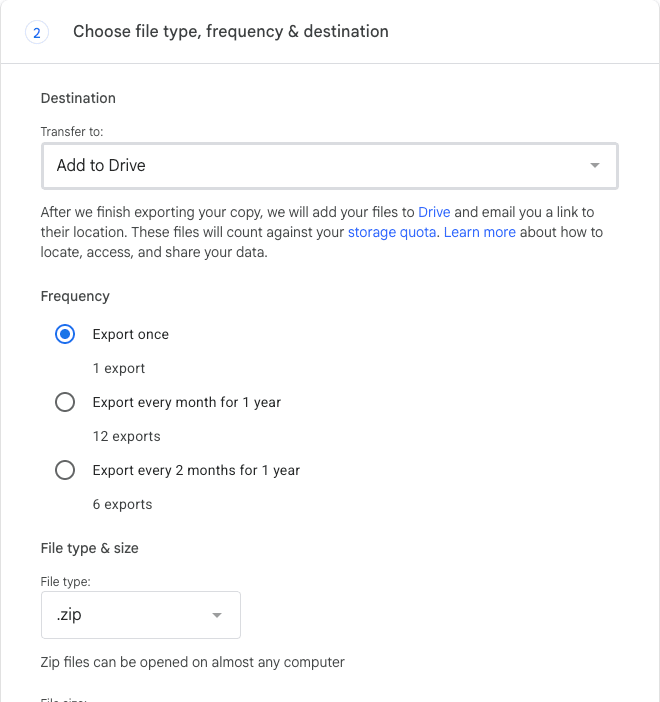
The delivery is set in Takeout's second step. Transfer to offers Add to Drive, and the page spells out the cost: "These files will count against your storage quota." Google then emails you a link to the files' location (Google Takeout help).
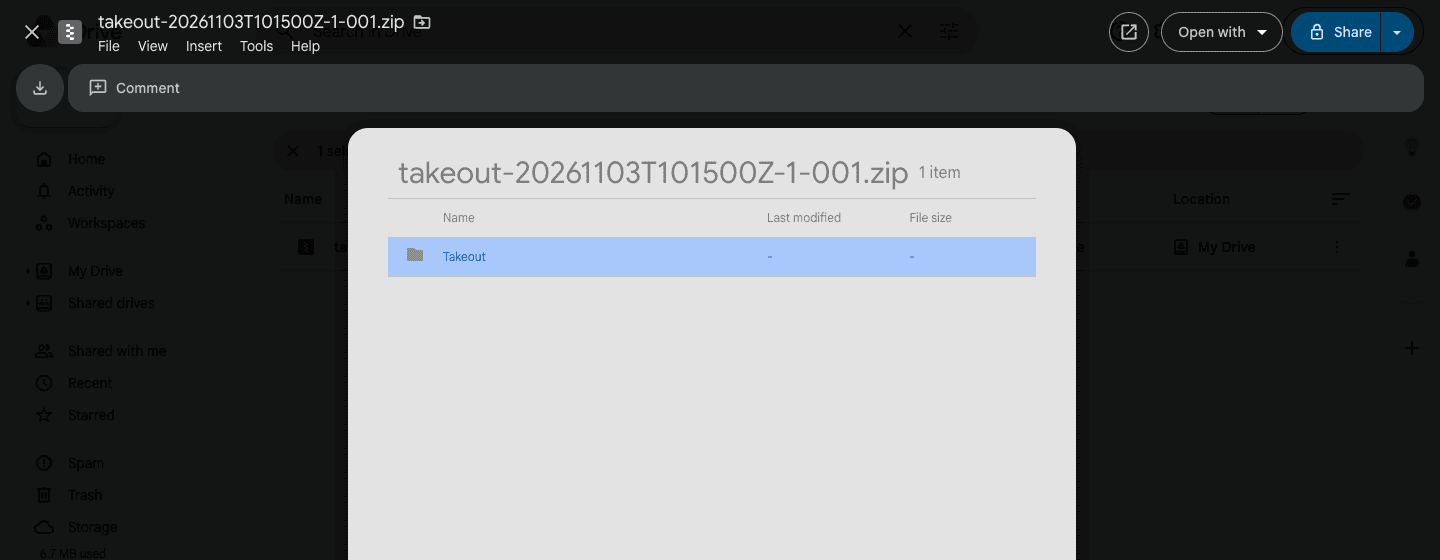
To see what happens next, we uploaded a test zip with the same layout as a Takeout export to a Drive account
and opened it. Drive shows a read-only list of the archive: one Takeout folder, with Name, Last
modified and File size columns. The toolbar has a download button and a comment button.
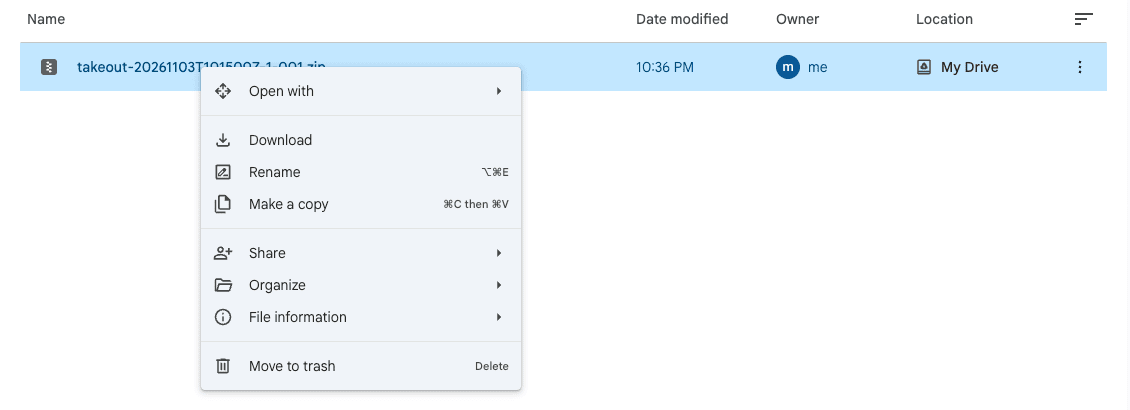
The right-click menu doesn't help either. It lists Open with, Download, Rename, Make a copy, Share, Organize, File information and Move to trash.
A large library is split into many of these files. At 2 GB per part, a 300 GB library is about 150 zips, and a single album can be spread over several of them, so extracting one zip wouldn't give you a complete album anyway.
The Storage Math Comes First
Google's quota is shared across Drive, Gmail and Google Photos. That matters more here than for any other Takeout destination, because the export lands in the same quota as the library it was made from. Assuming an original-quality library of size L, and copying only the year folders:
| Stage | One account | Zips in account A, folders in account B |
|---|---|---|
| Before the export | L (the library) | A: L |
| Zips delivered | 2 × L | A: 2 × L |
| Folders unpacked (the peak) | 3 × L | A: 2 × L, B: L |
| Zips deleted | 2 × L | A: L, B: L |
Copying album folders as well adds more, because album photos are stored twice in the export (see years, albums or both). For scale, every Google account includes 15 GB. Listed plans include Basic with 100 GB at $1.99 a month, 2 TB at $9.99 and 5 TB at $19.99, and prices vary by country (Google One plans). A 300 GB library in one account therefore needs about 900 GB at the peak, so check that figure against your plan before you create the export.
If the export is short of space in its own account, the other routes are to send it to OneDrive, Dropbox or Box and copy from there, or to choose Send download link via email and use a computer.
Method 1: Unpack the Zips in Place With CloudsLinker
CloudsLinker treats the zips in your Drive as a read-only drive. It merges every part's table of contents into one folder tree, so an album split across parts appears as one folder, and writes the photos into a Drive folder from its own servers. The free account's 10 GB of monthly transfer is enough to test a few folders; a whole library needs a paid plan.
Step 1: Send the Export to Drive
At takeout.google.com, click Deselect all, tick Google Photos and click Next step. Set Transfer to to Add to Drive (shown above), keep .zip, choose 2 GB or 10 GB and click Create export. Google may ask for your password again. Exports of large libraries can take hours or days; wait for the email. Then connect that account with Add Cloud → Google Drive, which signs in on Google's own page.
Step 2: Add the Takeout Folder as a Google Takeout
Open Add Cloud, search for takeout and choose Google Takeout. Set
Cloud with your export to Google Drive and tick the Takeout folder. A ticked folder
brings in every .zip inside it, so you don't select the parts one by one. Click Check archives.
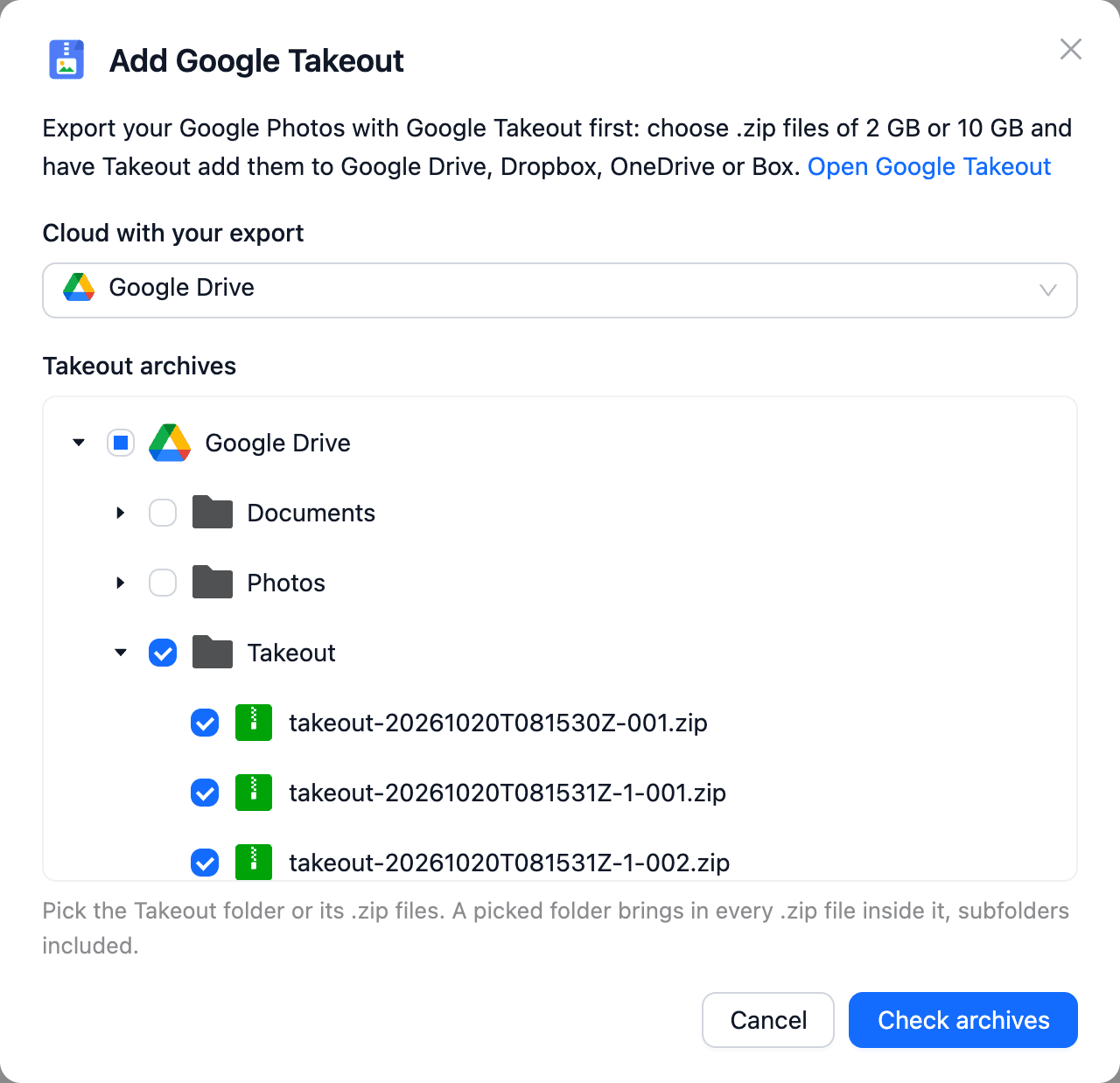
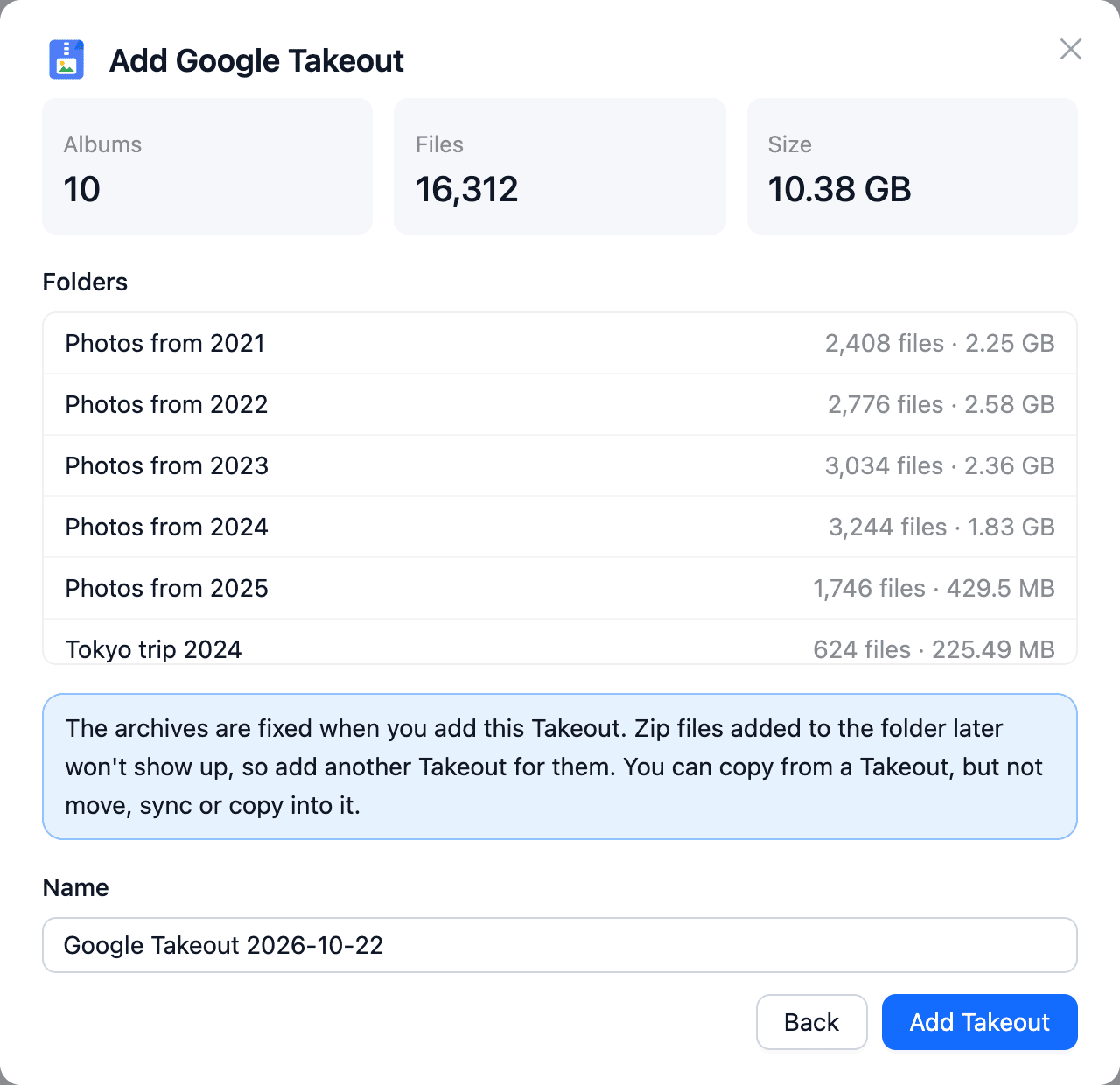
CloudsLinker lists the top-level folders, file count and unpacked size, plus any part it can't read, such as a .tgz or damaged file. Name the Takeout and click Add Takeout. The list of zips is fixed at this point, so wait until every part has arrived.
Step 3: Copy the Year Folders to a Drive Folder
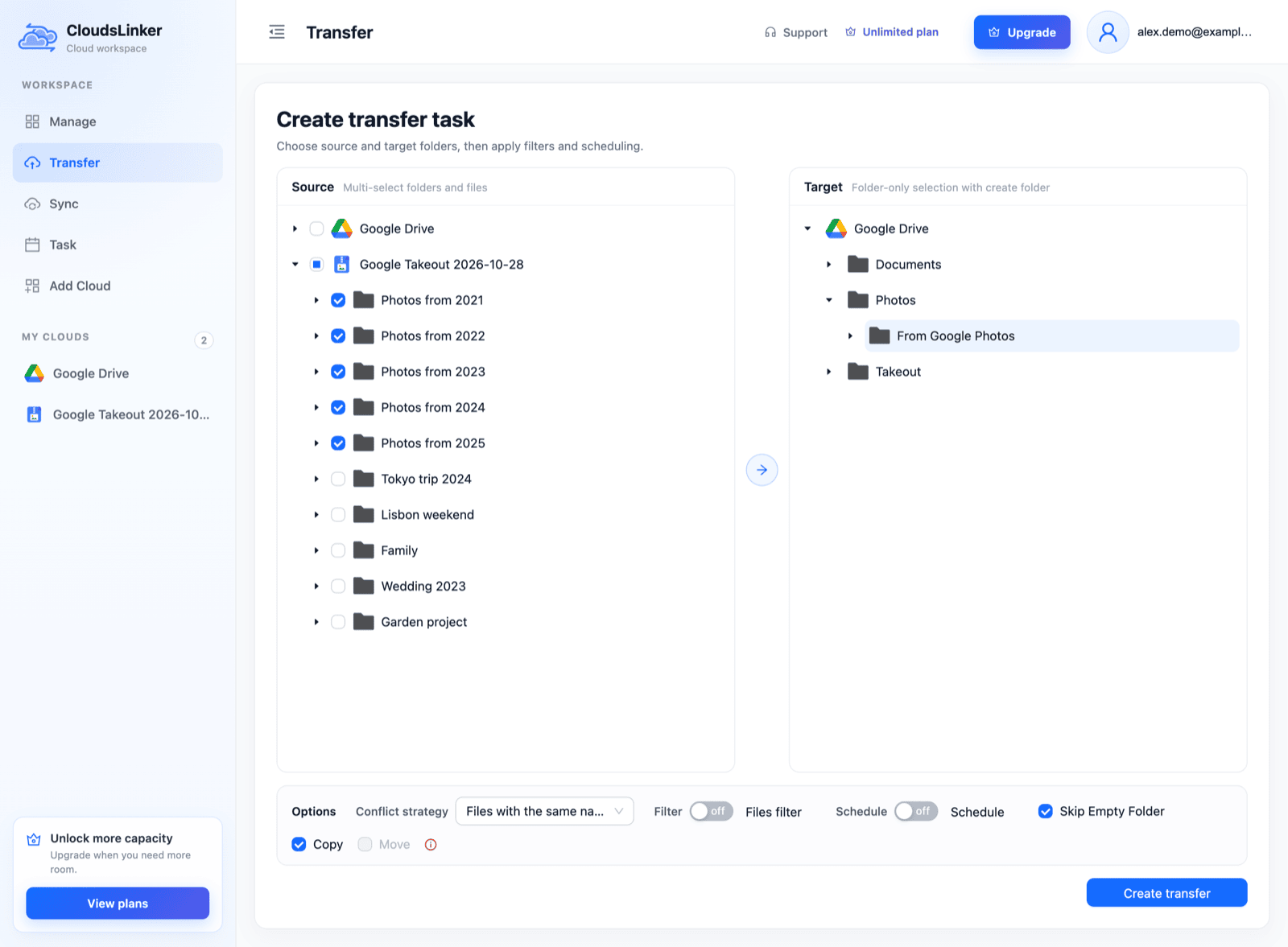
Open Transfer. In Source, expand the Takeout and tick the
Photos from YYYY folders, which hold every photo once. In Target, expand Google Drive
and pick or create a normal folder, here Photos/From Google Photos, rather than the
Takeout folder holding the zips. Copy is selected and Move is
unavailable, because a Takeout is read-only. Click Create transfer.
Step 4: Check the Counts and Delete the Zips
The copy runs on CloudsLinker's servers, so you can close the browser. Task monitor shows files and bytes done and the speed, and each file is checked against the CRC-32 checksum stored in its zip.
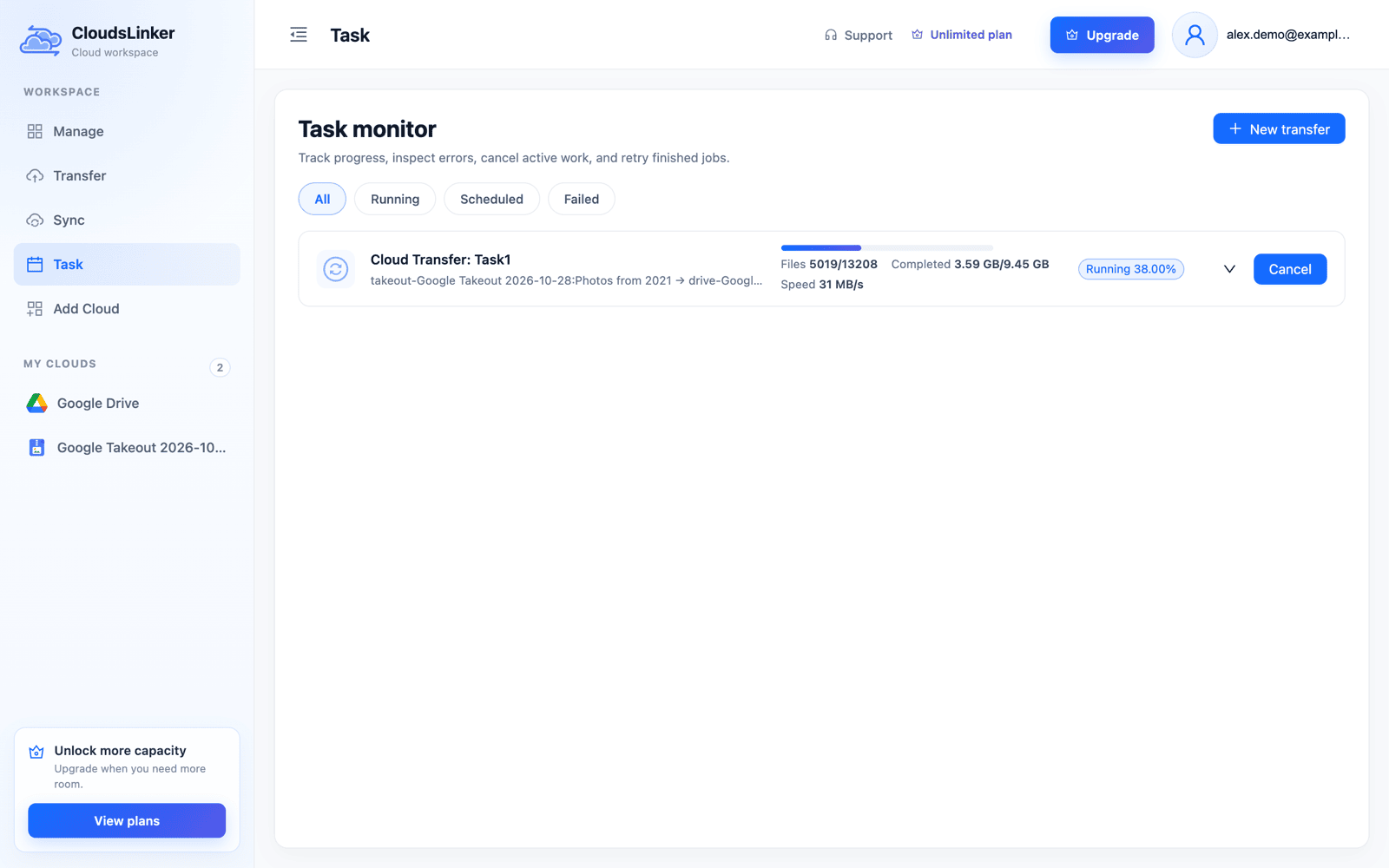
Treat the status as a prompt to check, not as the result: a task that ends as PartialSuccess may have stopped at a limit. Compare the completed file count with the review step, then run the task again if anything is missing. When the counts match, delete the zips and empty them from Drive's trash, since trashed files still use storage. Remove the Google Takeout from CloudsLinker as well, because it can't read zips that no longer exist.
Variation: Unpack Into a Second Google Account
This is the way around the three-times peak. It also suits a move away from an old address, such as a school account that is closing.
- Create the export in the old account with Add to Drive, as in Step 1.
- Connect both Google Drive accounts to CloudsLinker. Each signs in on Google's page, so use the account picker to choose the right one, and rename the connections so you can tell them apart.
- Add the Google Takeout from the old account's Drive, as in Step 2.
- On Transfer, tick the year folders in the Takeout and pick a folder in the new account's Drive, or a Shared drive you can write to, as the target.
- Keep the old account until the counts match, because the zips have to stay readable for the whole copy.
Files copied this way are owned by the target account and count against its quota, not the old one's. If you only need Drive files moved between accounts rather than a photo export, use the Drive-to-Drive guide instead.
Method 2: Extract on a Computer, Upload the Folder
This needs no third-party service, only disk space and time. Plan for the zips and the photos on disk at once, about twice the export, and count the transfer twice: down, then up.
-
Get the parts onto your computer. In Drive, open the
Takeoutfolder from Google's email, select the parts and download them. Selecting many at once makes Drive pack them into further zips, so downloading a few at a time is easier to keep track of. - Extract every part into the same folder. Albums split across parts merge back together this way. Use 7-Zip on Windows or The Unarchiver on macOS for parts over 4 GB.
-
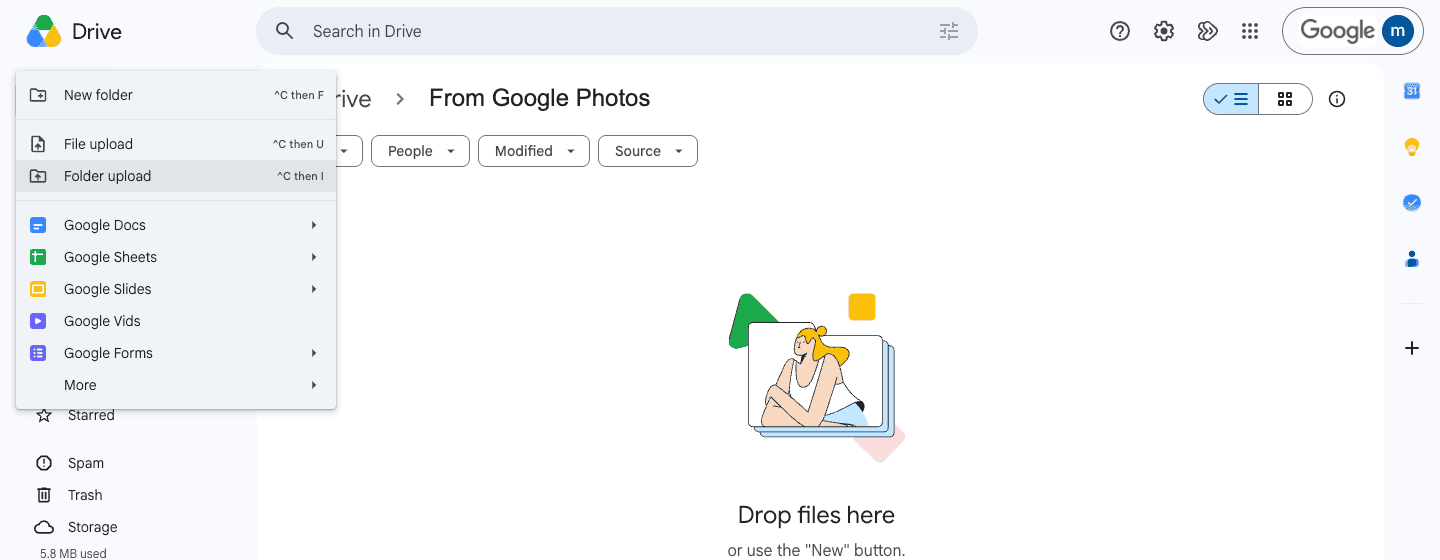
Upload the folder. In Drive, open the destination folder and choose New → Folder
upload, then pick the
Google Photosfolder or just itsPhotos from YYYYfolders. For large libraries, Drive for desktop is more forgiving of interruptions than a browser tab. - Delete the zips from Drive, empty the trash, and remove the local copies once the counts match.
Other Routes You'll See Mentioned
| Route | What to expect |
|---|---|
| Browser-based zip apps under Open with, such as ZIP Extractor | The work happens on your device, not on a server: ZIP Extractor's FAQ says archives are processed in your browser and that up to about 2 GB opens reliably on most computers (ZIP Extractor FAQ). That can work for a few parts, one at a time. Dozens of parts mean dozens of runs. |
| Making the export smaller | Takeout's All photo albums included button lets you export selected albums, so each export stays small enough to handle by hand. |
| Leaving the zips as they are | A reasonable cold backup if you only want a safety copy. You can't browse the photos without opening the archives, and the export reflects only the day it was made. |
Limits That Can Stop the Copy
| Limit | Number | What to do |
|---|---|---|
| CloudsLinker free transfer | 10 GB a month (plans) | Test with one year folder. A larger export stops when the allowance runs out, so check the plan before starting |
| Google's daily upload and copy limit | 750 GB per user per 24 hours (Google) | A 2 TB library takes at least three days. Run the task again after the limit resets; matching files are skipped |
| Google storage | 15 GB free, shared with Gmail and Photos | Do the math above first, including trashed files |
| Zips per Google Takeout in CloudsLinker | 500 | At 2 GB per part that covers about 1 TB; use 10 GB parts for more |
| Archive format | .zip only | .tgz and password-protected zips are reported as unreadable and left out |
Frequently Asked Questions
Conclusion
Drive stores Takeout zips and lists their contents, but it doesn't extract them. CloudsLinker reads the parts where Takeout left them and copies the year or album folders into a normal Drive folder, in the same account or a second one, without a download. Extracting on a computer needs no other service if your disk can hold the zips and the photos at once. Either way, work out the storage before you start, delete the zips when the file counts match, and remember that files in Drive don't appear in Google Photos.
Related: unzip Google Takeout in the cloud, Google Takeout to OneDrive, Google Takeout to Dropbox, copy Google Photos to a second account and Google Drive connection notes.
Online Storage Services Supported by CloudsLinker
Transfer data between over 60 cloud services with CloudsLinker

OneDrive

Google Drive

Google Photos

Google Takeout

Shared Drive

OneDrive for Business

Dropbox

Box

Mega

pCloud

Yandex

ProtonDrive

AWS

GCS

iDrive

Storj

DigitalOcean

Wasabi

1fichier

PikPak

TeleBox

OpenDrive

Backblaze B2

Fastmail file

SharePoint

Nextcloud

ownCloud

Premiumize me

HiDrive

Put.io

Sugar Sync

SmugMug

Jottacloud

Seafile
Ftp

SFtp

NAS

WebDav

4shared

Icedrive

Cloudflare R2

Scaleway

Hetzner Object Storage

Synology C2 Object Storage

S3 Compatible

Doi

iCloud Drive

iCloud Photos

FileLU

Zoho WorkDrive

Telia Cloud / Sky

Drime

Filen

TeraBox

Internxt

Degoo

Gofile

Pixeldrain

Shade

Koofr
Didn' t find your cloud service? Be free to contact: [email protected]
Further Reading
Effortless FTP connect to google drive: Transfer Files in 3 Easy Ways
Learn More >
Google Photos to OneDrive: 3 Innovative Transfer Strategies
Learn More >
Google Photos to Proton Drive: 3 Effective Transfer Techniques
Learn More >